Categories
Conversations

German Conversations Day 18 (School Checklist)


Section 1: Sentences with English and German Translations

English SentenceGerman Translation
I will give you some things you need to buy.Ich werde Ihnen einige Dinge geben, die Sie kaufen müssen.
You need a stapler, an organizer.Sie brauchen einen Hefter, einen Organizer.
You need colors and post-it notes.Sie brauchen Farben und Haftnotizen.
You need a schoolbag.Sie brauchen eine Schultasche.
You need a water bottle.Sie brauchen eine Trinkflasche.
You need to ensure your child remembers your phone number.Sie müssen sicherstellen, dass Ihr Kind Ihre Telefonnummer kennt.
You need to mention who all are authorized to pick up your child.Sie müssen angeben, wer Ihr Kind abholen darf.
You need to mention if your child has any allergies.Sie müssen angeben, ob Ihr Kind Allergien hat.
You need to indicate if you have some special needs regarding your religion.Sie müssen angeben, ob Sie besondere Bedürfnisse im Hinblick auf Ihre Religion haben.

Section 2: German Nouns from the Sentences

German Article + NounEnglish Translation
der Hefterthe stapler
der Organizerthe organizer
die Farbenthe colors
die Haftnotizenthe post-it notes
die Schultaschethe schoolbag
die Trinkflaschethe water bottle
die Telefonnummerthe phone number
die Allergienthe allergies
die Religionthe religion
die Bedürfnissethe needs

Section 3: Verbs Used in the Sentences

German VerbEnglish Translation
gebento give
brauchento need
sicherstellento ensure
kennento know
angebento mention/indicate
habento have

Section 4: Adjectives Used in the Sentences

German AdjectiveEnglish Translation
einigesome
besonderespecial

Section 5: Adverbs Used in the Sentences

German AdverbEnglish Translation
sichersure

Section 6: Prepositions Used in the Sentences

German PrepositionEnglish Translation
mitwith
aufon/about

Section 7: Grammar Byte for Today

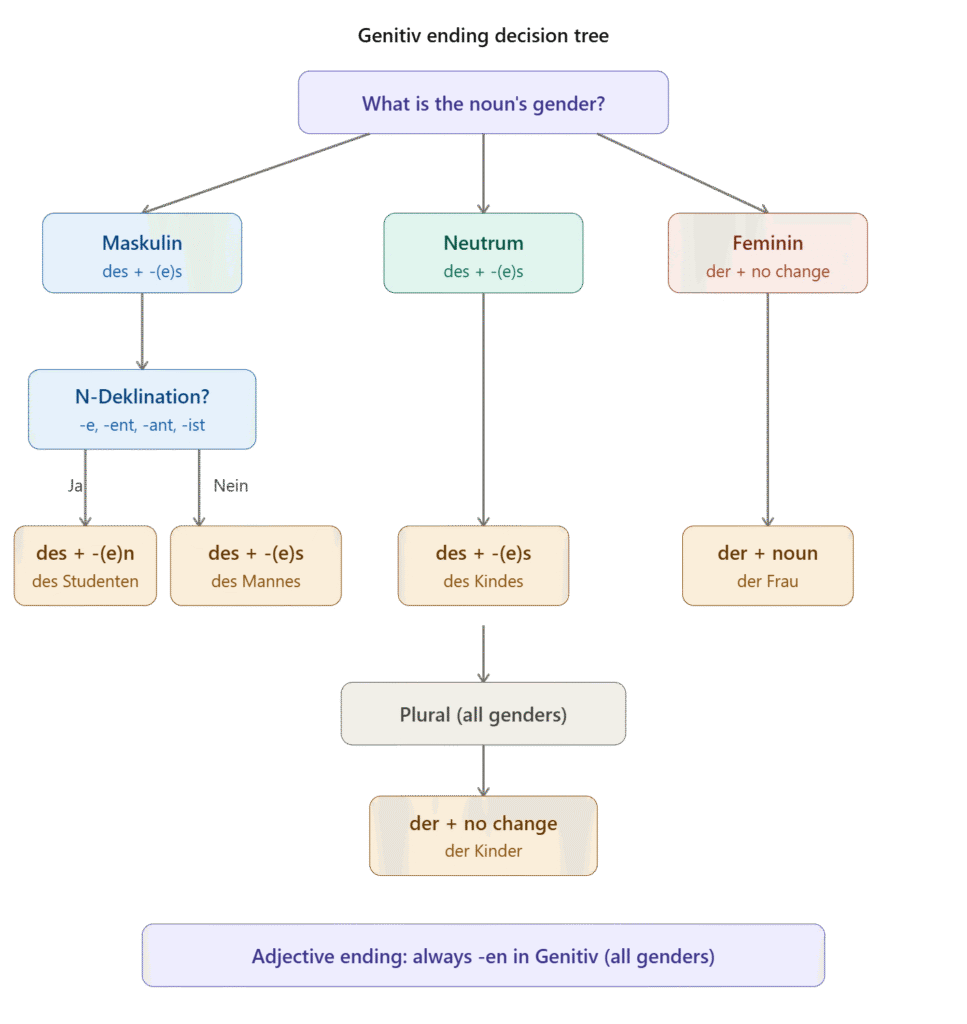
Basic Introduction to the Genitive Case: The genitive case in German shows possession or a close relationship between two nouns. It is often translated as “of” or with an apostrophe in English.

Examples:

  • Das Buch des Lehrers. (The teacher’s book.)
  • Die Tasche der Frau. (The woman’s bag.)

Articles in the genitive case:

  • Masculine: der → des (add -s or -es to the noun)
  • Feminine: die → der
  • Neutral: das → des (add -s or -es to the noun)
  • Plural: die → der

Section 8: German Idiom

LanguageIdiomMeaning
GermanJemandem die Daumen drücken.To keep one’s fingers crossed.
EnglishTo hope for someone’s success.
HindiKisi ke liye dua karna.

Section 9: Bollywood Dialogue

LanguageDialogue
OriginalKutte main tera khoon pee jaaonga”
German“Hund, ich werde dein Blut trinken!”
English“You Dog, I will drink your blood!”

Section 10: Study Tip

Tip: Label common household items with their German names. Seeing them daily will reinforce vocabulary in a practical and effective way.

Categories
Conversations

German Conversations Day 17 (First Day at Gymnasium)


Section 1: Sentences with English and German Translations

English SentenceGerman Translation
I am Herr Mustermann. I will be your point of contact for Gymnasium.Ich bin Herr Mustermann. Ich werde Ihr Ansprechpartner für das Gymnasium sein.
You need to know that your child will need to work hard, but we will support that.Sie müssen wissen, dass Ihr Kind hart arbeiten muss, aber wir werden das unterstützen.
Try engaging with the community and other kids—that will help you.Versuchen Sie, sich mit der Gemeinschaft und anderen Kindern zu engagieren – das wird Ihnen helfen.
We will arrange extra classes for German, but you can also make private arrangements if you wish.Wir werden Zusatzunterricht für Deutsch organisieren, aber Sie können auch private Vereinbarungen treffen, wenn Sie möchten.
Kids pick up languages very easily.Kinder lernen Sprachen sehr leicht.
We have many success stories.Wir haben viele Erfolgsgeschichten.
Learning a language will help your child integrate.Eine Sprache zu lernen, wird Ihrem Kind helfen, sich zu integrieren.
It will also make him more confident.Es wird ihm auch mehr Selbstvertrauen geben.
It will help you also better integrate into this country.Es wird auch Ihnen helfen, sich besser in dieses Land zu integrieren.
It will be fun. Trust me. We have done this hundreds of times.Es wird Spaß machen. Vertrauen Sie mir. Wir haben das schon hunderte Male gemacht.

Section 2: German Nouns from the Sentences

German Article + NounEnglish Translation
das Gymnasiumthe high school
der Ansprechpartnerthe point of contact
das Kindthe child
die Gemeinschaftthe community
der Zusatzunterrichtthe extra classes
die Sprachethe language
die Erfolgsgeschichtethe success story
das Selbstvertrauenthe confidence
das Landthe country

Section 3: Verbs Used in the Sentences

German VerbEnglish Translation
seinto be
wissento know
müssento have to
unterstützento support
versuchento try
engagierento engage
organisierento organize
lernento learn
helfento help
gebento give

Section 4: Adjectives Used in the Sentences

German AdjectiveEnglish Translation
harthard
leichteasy
vielemany
besserbetter
hundertehundreds
spaßigfun

Section 5: Adverbs Used in the Sentences

German AdverbEnglish Translation
sehrvery
auchalso

Section 6: Prepositions Used in the Sentences

German PrepositionEnglish Translation
fürfor
mitwith
inin

Section 7: Grammar Byte for Today

Examples of the Genitive Case: The genitive case in German shows possession or a close relationship between two nouns. It is often translated as “of” or with an apostrophe in English.

Examples:

  • Das Buch des Schülers. (The student’s book.)
  • Der Erfolg des Projekts. (The success of the project.)

Articles in the genitive case:

  • Masculine: der → des (add -s or -es to the noun)
  • Feminine: die → der
  • Neutral: das → des (add -s or -es to the noun)
  • Plural: die → der

Section 8: German Idiom

LanguageIdiomMeaning
GermanEtwas durch die Blume sagen.To say something indirectly.
EnglishTo say something in a roundabout way.
HindiKisi baat ko ghoom-phir ke kehna.

Section 9: Bollywood Dialogue

LanguageDialogue
OriginalAree oh Sambha, kitna inaam rakha hai sarkar hum par?
GermanHey Sambha, wie viel Belohnung hat die Regierung auf uns gesetzt?
EnglishHey Sambha, how much reward has the government put on us?

Section 10: Study Tip

Tip: Practice speaking with native speakers or language partners. Conversations will help you understand nuances and improve fluency faster!

Categories
Conversations

German Conversations Day 16 (First Day at the School)


Section 1: Sentences with English and German Translations

English SentenceGerman Translation
I am Frau Benedikt. I will be the class teacher in Grundschule.Ich bin Frau Benedikt. Ich werde die Klassenlehrerin in der Grundschule sein.
I am Anika. I am really scared.Ich bin Anika. Ich habe wirklich Angst.
Why are you scared?Warum hast du Angst?
My child knows no German.Mein Kind kann kein Deutsch.
Don’t worry. We have programs to include foreign children.Machen Sie sich keine Sorgen. Wir haben Programme, um ausländische Kinder einzubinden.
My child is really good in English.Mein Kind ist wirklich gut in Englisch.
We may convert many of his English classes to German classes.Wir können viele seiner Englischstunden in Deutschstunden umwandeln.
So sweet of you.Das ist so lieb von Ihnen.
Is there an aftercare after school?Gibt es eine Nachmittagsbetreuung nach der Schule?
You can enquire in the Sekretariat. We have some options.Sie können sich im Sekretariat erkundigen. Wir haben einige Optionen.

Section 2: German Nouns from the Sentences

German Article + NounEnglish Translation
die Klassenlehrerinthe class teacher (female)
die Grundschulethe primary school
die Angstthe fear
das Kindthe child
das Programmthe program
das Deutschthe German
das Englischthe English
die Stundethe class/hour
die Nachmittagsbetreuungthe aftercare
das Sekretariatthe school office

Section 3: Verbs Used in the Sentences

German VerbEnglish Translation
seinto be
habento have
könnento be able to/can
machento make/do
einbindento include/integrate
umwandelnto convert
erkundigento enquire

Section 4: Adjectives Used in the Sentences

German AdjectiveEnglish Translation
wirklichreally
liebsweet
ausländischforeign
gutgood

Section 5: Adverbs Used in the Sentences

German AdverbEnglish Translation
wirklichreally
soso

Section 6: Prepositions Used in the Sentences

German PrepositionEnglish Translation
inin
nachafter
vonof/from

Section 7: Grammar Byte for Today

Examples of the Dative Case: The dative case in German is used for the indirect object of a sentence—the person or thing to or for whom something is done.

Examples:

  • Ich gebe dem Kind das Buch. (I give the book to the child.)
    • “dem Kind” is the indirect object and takes the dative case.
  • Ich helfe der Lehrerin. (I help the teacher.)
    • “der Lehrerin” is in the dative case because “helfen” requires it.

Articles in the dative case:

  • Masculine: der → dem
  • Feminine: die → der
  • Neutral: das → dem
  • Plural: die → den (add “-n” to the noun if possible)

Section 8: German Idiom

LanguageIdiomMeaning
GermanDas Leben ist kein Ponyhof.Life is not a bed of roses.
EnglishLife is not always easy.
HindiZindagi hamesha aasan nahi hoti.

Section 9: Bollywood Dialogue

LanguageDialogue
Originalaaj mere pass bangla hai , gaadi hai , bank balance hai , tumhare pass kya hai ? Mere pass Maa hai
GermanHeute habe ich ein Bungalow, ein Auto, ein Bankguthaben. Was hast du? Ich habe meine Mutter bei mir.
English“Today, I have a bungalow, a car, and a bank balance. What do you have?
I have my mother.”

Section 10: Study Tip

Tip: Practice listening to German audio daily. Try children’s stories or beginner podcasts—they are slow and clear, perfect for learners!

Categories
Conversations

German Conversations Day 15 (Finding the School)


Section 1: Sentences with English and German Translations

English SentenceGerman Translation
I need to find a school for my kids.Ich muss eine Schule für meine Kinder finden.
How old are your kids?Wie alt sind Ihre Kinder?
One is 7 and the other is 12.Eins ist sieben und das andere ist zwölf.
Oh, so you need one Grundschule and one Gymnasium.Oh, also brauchen Sie eine Grundschule und ein Gymnasium.
How do I find a Grundschule?Wie finde ich eine Grundschule?
Just talk to neighbors or visit the Rathaus.Sprechen Sie einfach mit Nachbarn oder besuchen Sie das Rathaus.
How do I apply for admission?Wie bewerbe ich mich um eine Aufnahme?
In Germany, every child has the right to be educated in the school nearby.In Deutschland hat jedes Kind das Recht, in der nächstgelegenen Schule unterrichtet zu werden.
Are some schools good and some bad?Sind einige Schulen gut und andere schlecht?
The government ensures the same standards in all schools. You can relax.Die Regierung sorgt für gleiche Standards in allen Schulen. Sie können sich entspannen.

Section 2: German Nouns from the Sentences

German Article + NounEnglish Translation
die Schulethe school
die Kinderthe kids
die Grundschulethe primary school
das Gymnasiumthe high school
die Nachbarnthe neighbors
das Rathausthe town hall
die Aufnahmethe admission
das Rechtthe right
die Standardsthe standards
die Regierungthe government

Section 3: Verbs Used in the Sentences

German VerbEnglish Translation
findento find
seinto be
brauchento need
sprechento speak
besuchento visit
bewerbento apply
habento have
sorgento ensure
entspannento relax

Section 4: Adjectives Used in the Sentences

German AdjectiveEnglish Translation
altold
nächstgelegennearby
gutgood
schlechtbad
gleichsame
entspanntrelaxed

Section 5: Adverbs Used in the Sentences

German AdverbEnglish Translation
einfachsimply
soso

Section 6: Prepositions Used in the Sentences

German PrepositionEnglish Translation
fürfor
mitwith
inin
zuto

Section 7: Grammar Byte for Today

Basic Introduction to the Dative Case: The dative case in German is used to indicate the indirect object of a sentence—the person or thing to or for whom something is done.

Examples:

  • Ich gebe dem Kind das Buch. (I give the book to the child.)
    • “dem Kind” is the indirect object and takes the dative case.

Articles in the dative case:

  • Masculine: der → dem
  • Feminine: die → der
  • Neutral: das → dem
  • Plural: die → den (add “-n” to the noun if possible)

Section 8: German Idiom

LanguageIdiomMeaning
GermanDie Kirche im Dorf lassen.Keep things in perspective.
EnglishDon’t make a mountain out of a molehill.
HindiBaat ka batangad mat banao.

Section 9: Bollywood Dialogue

LanguageDialogue
OriginalJaa Simran jaa, jee le apni zindagi.
GermanGeh, Simran, lebe dein Leben!
EnglishGo, Simran, live your life!

Section 10: Study Tip

Tip: When learning new vocabulary, try to use it in sentences immediately. This will help reinforce its meaning and context effectively.

Call to Action : If you like this content think of following on X and whatsapp and never miss an update

Disclaimer: Please do not take the content too seriously. The posts are generated with AI and can have mistakes. The author does not take any responsibility for accuracy or correctness of the provided information and cannot be held responsible for any damages occurring because of false or incorrect information.

Categories
Conversations

German Conversations Day 14 (Contract)

Home » Page 13

Section 1: Sentences with English and German Translations

English SentenceGerman Translation
I really like the apartment. Can we sign the contract?Ich mag die Wohnung wirklich. Können wir den Vertrag unterschreiben?
I think you should review the wording first.Ich denke, Sie sollten den Wortlaut zuerst überprüfen.
What are the terms and conditions?Was sind die Allgemeinen Geschäftsbedingungen?
I will send you a PDF. You can read it in peace.Ich werde Ihnen eine PDF schicken. Sie können sie in Ruhe lesen.
If I sign today, can I cancel the contract?Wenn ich heute unterschreibe, kann ich den Vertrag kündigen?
The cancellation clause is mentioned in the contract wording.Die Kündigungsklausel wird im Vertragswortlaut erwähnt.
Do I need to get the contract notarized?Muss ich den Vertrag notariell beglaubigen lassen?
Not needed, the signature of parties is sufficient.Nicht nötig, die Unterschrift der Parteien reicht aus.
Do I need to mention a standing order in the contract for payments?Muss ich einen Dauerauftrag für Zahlungen im Vertrag erwähnen?
You can do that or just pay every month on time. It’s your choice.Sie können das tun oder einfach jeden Monat pünktlich zahlen. Es ist Ihre Wahl.

Section 2: German Nouns from the Sentences

German Article + NounEnglish Translation
die Wohnungthe apartment
der Vertragthe contract
der Wortlautthe wording
die Bedingungenthe conditions
die PDFthe PDF
die Kündigungsklauselthe cancellation clause
die Unterschriftthe signature
der Dauerauftragthe standing order
die Parteienthe parties
die Zahlungthe payment

Section 3: Verbs Used in the Sentences

German VerbEnglish Translation
mögento like
könnento be able to/can
überprüfento review/check
sendento send
lesento read
unterschreibento sign
kündigento cancel
erwähnento mention
beglaubigento notarize
zahlento pay

Section 4: Adjectives Used in the Sentences

German AdjectiveEnglish Translation
wirklichreally
ruhigpeaceful
nötignecessary
pünktlichon time
ausreichendsufficient

Section 5: Adverbs Used in the Sentences

German AdverbEnglish Translation
zuerstfirst
in Ruhein peace
heutetoday
einfachsimply
jeden Monatevery month

Section 6: Prepositions Used in the Sentences

German PrepositionEnglish Translation
inin
fürfor
mitwith
vonof/from

Section 7: Grammar Byte for Today

Basic Examples of the Accusative Case: The accusative case in German is used to show the direct object of a sentence—the thing directly receiving the action.

Examples:

  • Ich mag die Wohnung. (I like the apartment.)
  • Note: “die Wohnung” is the direct object and remains “die” because it’s feminine.
  • Ich sehe den Vertrag. (I see the contract.)
  • Note: “der Vertrag” changes to “den Vertrag” because it’s masculine in the accusative case.

Section 8: German Idiom

Idiom: Den Nagel auf den Kopf treffen.

Meaning in English: To hit the nail on the head. Meaning in Hindi: Samasya ka bilkul sahi hal dena.


Section 9: Bollywood Dialogue

Original Dialogue: Basanti, in kutton ke saamne mat nachna!

In German: Basanti, tanz nicht vor diesen Hunden!


Section 10: Study Tip

Tip: Practice forming complete sentences using newly learned vocabulary. Write them down and read them aloud to improve both writing and speaking skills.

Call to Action : If you like this content think of following on X and whatsapp and never miss an update

Disclaimer: Please do not take the content too seriously. The posts are generated with AI and can have mistakes. The author does not take any responsibility for accuracy or correctness of the provided information and cannot be held responsible for any damages occurring because of false or incorrect information.

Categories
Accomodation Conversations

German Conversations Day 13(Badezimmer)


Section 1: Sentences with English and German Translations

English SentenceGerman Translation
Let’s look at the bathroom now.Schauen wir uns jetzt das Badezimmer an.
We have a walk-in shower and a matching washbasin.Wir haben eine begehbare Dusche und ein passendes Waschbecken.
The bathroom was renovated just five years earlier.Das Badezimmer wurde erst vor fünf Jahren renoviert.
There is a guest toilet close to the entrance.Es gibt eine Gästetoilette in der Nähe des Eingangs.
There is a place for washing machine and dryer also.Es gibt auch einen Platz für Waschmaschine und Trockner.
There is a towel rack for hanging towels.Es gibt einen Handtuchhalter zum Aufhängen von Handtüchern.
The tiles are anti-slip.Die Fliesen sind rutschfest.
The door has a special lock that can be opened from outside in an emergency if children lock it.Die Tür hat ein spezielles Schloss, das im Notfall von außen geöffnet werden kann, falls Kinder sie versehentlich abschließen.
There is an exhaust ensuring air circulation.Es gibt eine Abluftanlage, die für Luftzirkulation sorgt.
There is a beautiful mirror with light, 1 electrical switch, and 1 electrical socket.Es gibt einen schönen Spiegel mit Beleuchtung, einem Lichtschalter und einer Steckdose.

Section 2: German Nouns from the Sentences

German Article + NounEnglish Translation
das Badezimmerthe bathroom
die Duschethe shower
das Waschbeckenthe washbasin
die Gästetoilettethe guest toilet
die Waschmaschinethe washing machine
der Trocknerthe dryer
der Handtuchhalterthe towel rack
die Fliesenthe tiles
der Spiegelthe mirror
der Lichtschalterthe light switch
die Steckdosethe electrical socket

Section 3: Verbs Used in the Sentences

German VerbEnglish Translation
schauento look
habento have
renovierento renovate
gebento give/there is
aufhängento hang
seinto be
sorgento ensure
öffnento open
abschließento lock

Section 4: Adjectives Used in the Sentences

German AdjectiveEnglish Translation
begehbarwalk-in
passendmatching
renoviertrenovated
nahclose
rutschfestanti-slip
schönbeautiful
speziellspecial

Section 5: Adverbs Used in the Sentences

German AdverbEnglish Translation
jetztnow
erstjust/only
auchalso
im Notfallin an emergency

Section 6: Prepositions Used in the Sentences

German PrepositionEnglish Translation
anat/on
vorbefore
inin
fürfor
mitwith

Section 7: Grammar Byte for Today

Introduction to the Accusative Case: The accusative case in German is used for the direct object of a sentence—the thing directly receiving the action of the verb.

Example:

  • Ich sehe den Spiegel. (I see the mirror.)
  • Note: “der Spiegel” (nominative) changes to “den Spiegel” (accusative).

Articles in the accusative case:

  • Masculine: der → den
  • Feminine: die → die (no change)
  • Neutral: das → das (no change)
  • Plural: die → die (no change)

Section 8: German Idiom

Idiom: Alles in Butter.

Meaning in English: Everything is fine.

Meaning in Hindi: Sab kuch theek hai.


Section 9: Bollywood Dialogue

Original Dialogue: Rishtey mein toh hum tumhare baap lagte hain, naam hai Shahenshah.

In German: In der Beziehung sind wir wie dein Vater, und unser Name ist Shahenshah.


Section 10: Study Tip

Tip: Practice speaking German daily, even if it’s just for five minutes. Consistency is key to fluency.

Call to Action : If you like this content think of following on X and whatsapp and never miss an update

Disclaimer: Please do not take the content too seriously. The posts are generated with AI and can have mistakes. The author does not take any responsibility for accuracy or correctness of the provided information and cannot be held responsible for any damages occurring because of false or incorrect information.

Categories
Accomodation Conversations

German Convsersations – Day 12(Schlafzimmer)

English: Welcome to today’s German learning blog! Let’s explore useful sentences, vocabulary, and grammar to enhance your German skills. Have fun learning!
German: Willkommen beim heutigen Deutsch-Lernblog! Lassen Sie uns nützliche Sätze, Vokabeln und Grammatik entdecken, um Ihre Deutschkenntnisse zu verbessern. Viel Spaß beim Lernen!


Section 1: Sentences with Translations

English SentenceGerman Translation
Can you show me the bedroom?Können Sie mir das Schlafzimmer zeigen?
Sure, this way please.Natürlich, bitte hier entlang.
I like the big bed and the side tables.Mir gefallen das große Bett und die Nachttische.
You can also see the spacious cupboard.Sie können auch den geräumigen Schrank sehen.
I like the sliding door.Mir gefällt die Schiebetür.
There is a huge mirror also.Es gibt auch einen großen Spiegel.
Is there an attached bathroom?Gibt es ein angrenzendes Badezimmer?
No, the entrance to the bathroom is from the lobby.Nein, der Eingang zum Badezimmer ist vom Flur aus.
I like that you have space for the iron and ironing board.Ich mag, dass es Platz für das Bügeleisen und das Bügelbrett gibt.
The house is specially optimized for families.Das Haus ist speziell für Familien optimiert.

Section 2: Nouns

German Article + NounEnglish Translation
das Schlafzimmerthe bedroom
das Bettthe bed
der Nachttischthe side table
der Schrankthe cupboard
die Schiebetürthe sliding door
der Spiegelthe mirror
das Badezimmerthe bathroom
der Flurthe lobby
das Bügeleisenthe iron
das Bügelbrettthe ironing board
die Familiethe family

Section 3: Verbs

German VerbEnglish Translation
zeigento show
gefallento like
sehento see
gebento give (there is/are)
mögento like
optimierento optimize

Section 4: Adjectives

German AdjectiveEnglish Translation
großbig
geräumigspacious
angrenzendattached
speziellspecial
optimiertoptimized

Section 5: Adverbs

German AdverbEnglish Translation
natürlichsure/naturally
auchalso
bitteplease

Section 6: Prepositions

German PrepositionEnglish Translation
mitwith
vonfrom
fürfor
ausout/from

Section 7: Grammar Byte for Today

Common Structures in the Simple Present Tense
The Präsens (present tense) is used to describe actions happening now or in the near future.

  1. Regular Verb Conjugation:Verb (Infinitive)ichduer/sie/eswirihrsie/Siezeigen (to show)zeigezeigstzeigtzeigenzeigtzeigen
  2. Sentence Structure:
    • Subject + Verb + Object: Ich mag das Bett. (I like the bed.)
    • Question Word + Verb + Subject: Können Sie mir das zeigen? (Can you show me that?)

Section 8: German Idiom

Jemandem einen Bären aufbinden.
Meaning in English: To pull someone’s leg (literally: to tie a bear to someone).
Meaning in Hindi: किसी को बेवकूफ बनाना।


Section 9: Bollywood Dialogue

Original: “Bade bade deshon mein aisi chhoti chhoti baatein hoti rehti hain.”
German Translation: “In großen Ländern passieren solche kleinen Dinge immer wieder.”
Hindi Translation: “बड़े बड़े देशों में ऐसी छोटी छोटी बातें होती रहती हैं।”


Section 10: Study Tip

Create a Language Notebook: Dedicate a notebook for German learning. Divide it into sections for vocabulary, grammar rules, and practice exercises. Regularly review your notes to strengthen your understanding and retention.

Call to Action : If you like this content think of following on X and whatsapp and never miss an update

Disclaimer: Please do not take the content too seriously. The posts are generated with AI and can have mistakes. The author does not take any responsibility for accuracy or correctness of the provided information and cannot be held responsible for any damages occurring because of false or incorrect information.

Categories
Accomodation Conversations Uncategorized

German Conversations – Day 11(Wohnzimmer)

English: Welcome to today’s German learning blog! Let’s discover practical sentences, vocabulary, and grammar tips to improve your German. Viel Spaß beim Lernen!
German: Willkommen beim heutigen Deutsch-Lernblog! Lassen Sie uns praktische Sätze, Vokabeln und Grammatik-Tipps entdecken, um Ihr Deutsch zu verbessern. Viel Spaß beim Lernen!


Section 1: Sentences with Translations

English SentenceGerman Translation
Can you show me the living room?Können Sie mir das Wohnzimmer zeigen?
The living room has a sofa and a dining table.Das Wohnzimmer hat ein Sofa und einen Esstisch.
Is that TV also included?Ist der Fernseher auch dabei?
Yes, the house will be rented fully furnished.Ja, das Haus wird komplett möbliert vermietet.
This carpet is really beautiful.Dieser Teppich ist wirklich schön.
Thanks. It matches the colors of the curtains.Danke. Er passt zu den Farben der Vorhänge.
I also like the center table.Mir gefällt auch der Couchtisch.
Did you notice the bookshelf in this corner?Haben Sie das Bücherregal in dieser Ecke bemerkt?
Yes. I also like the fireplace. Perfect for reading.Ja. Mir gefällt auch der Kamin. Perfekt zum Lesen.
Shall I show you the other rooms?Soll ich Ihnen die anderen Zimmer zeigen?

Section 2: Nouns

German Article + NounEnglish Translation
das Wohnzimmerthe living room
das Sofathe sofa
der Esstischthe dining table
der Fernseherthe TV
das Hausthe house
der Teppichthe carpet
die Vorhängethe curtains
der Couchtischthe center table
das Bücherregalthe bookshelf
der Kaminthe fireplace

Section 3: Verbs

German VerbEnglish Translation
zeigento show
habento have
seinto be
vermietento rent
passento match
gefallento like
bemerkento notice
lesento read
mögento like
sollento shall/should

Section 4: Adjectives

German AdjectiveEnglish Translation
schönbeautiful
komplettfully
möbliertfurnished
perfektperfect
wirklichreally

Section 5: Adverbs

German AdverbEnglish Translation
auchalso
wirklichreally
komplettfully
dabeiincluded

Section 6: Prepositions

German PrepositionEnglish Translation
mitwith
zuto
inin
fürfor

Section 7: Grammar Byte for Today

Formal vs. Informal German
In German, the formality of language depends on the relationship between speakers:

  1. Formal Speech (Sie): Used in professional settings or with strangers. Example: Können Sie mir helfen? (Can you help me?)
  2. Informal Speech (du): Used with friends, family, or peers. Example: Kannst du mir helfen? (Can you help me?)
    Always use Sie unless someone invites you to use du.

Section 8: German Idiom

Ich verstehe nur Bahnhof.
Meaning in English: I don’t understand anything. (Literally: I only understand “train station.”)
Meaning in Hindi: मुझे कुछ समझ नहीं आ रहा।


Section 9: Bollywood Dialogue

Original: “Don ko pakadna mushkil hi nahi, namumkin hai.”
German Translation: “Don zu fangen ist nicht nur schwierig, sondern unmöglich.”
Hindi Translation: “डॉन को पकड़ना मुश्किल ही नहीं, नामुमकिन है।”


Section 10: Study Tip

Immersion is key: Surround yourself with German! Watch German TV shows, listen to podcasts, and try speaking with native speakers. Immersion accelerates vocabulary retention and improves pronunciation.

Call to Action : If you like this content think of following on X and whatsapp and never miss an update

Disclaimer: Please do not take the content too seriously. The posts are generated with AI and can have mistakes. The author does not take any responsibility for accuracy or correctness of the provided information and cannot be held responsible for any damages occurring because of false or incorrect information.

Categories
Accomodation Conversations

German Conversations – Day 10(Visit to the Apartment)

Welcome Message (English and German Translation)

English: Welcome to today’s German learning blog! Let’s dive into some practical sentences, vocabulary, and grammar to make your German journey enjoyable. Viel Erfolg!
German: Willkommen beim heutigen Deutsch-Lernblog! Lassen Sie uns in praktische Sätze, Vokabeln und Grammatik eintauchen, um Ihre Deutschreise angenehm zu gestalten. Viel Erfolg!


Section 1: Sentences with Translations

English SentenceGerman Translation
Hi Mathew, I am looking for a rental accommodation.Hallo Mathew, ich suche eine Mietwohnung.
Hi Anika, I am Mathew, your real estate agent. This house has a total of 3 rooms and a kitchen.Hallo Anika, ich bin Mathew, Ihr Immobilienmakler. Dieses Haus hat insgesamt 3 Zimmer und eine Küche.
Is there a fitted kitchen?Gibt es eine Einbauküche?
Yes, but it’s old. You can change it if you like.Ja, aber sie ist alt. Sie können sie ändern, wenn Sie möchten.
Is there a balcony?Gibt es einen Balkon?
Yes, the balcony faces the garden.Ja, der Balkon geht zum Garten hinaus.
What about the cellar?Wie sieht es mit dem Keller aus?
There is a cellar and a place to park bikes.Es gibt einen Keller und einen Platz zum Abstellen von Fahrrädern.
What’s the heating system?Wie sieht das Heizungssystem aus?
It’s central gas heating.Es ist eine zentrale Gasheizung.

Section 2: Nouns

German Article + NounEnglish Translation
die Mietwohnungrental accommodation
der Immobilienmaklerreal estate agent
das Haushouse
die Einbauküchefitted kitchen
der Balkonbalcony
der Gartengarden
der Kellercellar
das Fahrradbike
die Heizungheating
das Heizungssystemheating system

Section 3: Verbs

German VerbEnglish Translation
suchento search
seinto be
habento have
gibt (es gibt)there is/there are
mögento like
ändernto change
hinausgehento face/overlook
abstellento park/place
aussehento look (like)
funktionierento work/function

Section 4: Adjectives

German AdjectiveEnglish Translation
altold
zentralcentral
gesamttotal
passendfitted

Section 5: Adverbs

German AdverbEnglish Translation
insgesamtin total
hinausoutwards/towards

Section 6: Prepositions

German PrepositionEnglish Translation
mitwith
zum (zu + dem)to the
überabout

Section 7: Grammar Byte for Today

Introduction to German Pronouns
German pronouns replace nouns in a sentence and are essential for forming coherent and concise sentences. The most common personal pronouns are:

German PronounEnglish Translation
ichI
duyou (informal)
er/sie/eshe/she/it
wirwe
ihryou (plural informal)
sie/Siethey/you (formal)

Section 8: German Idiom

Das ist nicht mein Bier.
Meaning in English: That’s not my concern/problem.
Meaning in Hindi: यह मेरी समस्या नहीं है।


Section 9: Bollywood Dialogue

Original: “Kitne aadmi the?”
German Translation: “Wie viele Männer waren es?”
Hindi Translation: “कितने आदमी थे?”


Section 10: Study Tip

Consistency is key: Practice German daily, even if it’s for 10-15 minutes. Use apps, flashcards, or simple conversation to build a habit. Over time, consistency leads to noticeable improvement!

Call to Action : If you like this content think of following on X and whatsapp and never miss an update

Disclaimer: Please do not take the content too seriously. The posts are generated with AI and can have mistakes. The author does not take any responsibility for accuracy or correctness of the provided information and cannot be held responsible for any damages occurring because of false or incorrect information.

Categories
Conversations

German Conversations – Day 9(Let’s Talk about Time)

Welcome to Our German Language Blog!

English: Welcome to our blog, where learning German becomes fun and easy!
German: Willkommen auf unserem Blog, wo das Deutschlernen spaßig und einfach wird!


Section 1: English Sentences and Their German Translations

English SentenceGerman Translation
Come fast, we need to go to our house visiting appointment.Komm schnell, wir müssen zu unserem Hausbesichtigungstermin gehen.
What time is it?Wie spät ist es?
It’s 10 past six pm.Es ist zehn nach sechs Uhr abends.
We still have twenty minutes.Wir haben noch zwanzig Minuten.
It’s almost six pm.Es ist fast sechs Uhr abends.
Your watch is showing incorrect time, it’s fifty minutes past five.Deine Uhr zeigt die falsche Zeit, es ist fünfzig Minuten nach fünf.
We need approximately 5 minutes to park, remember.Wir brauchen ungefähr fünf Minuten zum Parken, denk dran.
Yes, you are right. Let’s go immediately.Ja, du hast recht. Lass uns sofort losgehen.
Better early than late.Lieber früh als spät.
I think we will be free by half past six.Ich denke, wir werden bis halb sieben frei sein.

Section 2: German Nouns

German Article and NounEnglish Translation
die Hausbesichtigungthe house visit
die Zeitthe time
die Uhrthe watch/clock
die Minutenthe minutes
der Terminthe appointment

Section 3: Verbs

German VerbEnglish Translation
kommento come
müssento need to
habento have
zeigento show
brauchento need

Section 4: Adjectives

German AdjectiveEnglish Translation
schnellfast
falschincorrect
ungefährapproximate
richtigcorrect
sofortimmediate

Section 5: Adverbs

German AdverbEnglish Translation
nochstill
fastalmost
ungefährapproximately
sofortimmediately
lieberpreferably

Section 6: Prepositions

German PrepositionEnglish Translation
zuto
nachafter
fürfor
bisuntil
mitwith

Section 7: Hindi Translations

German WordHindi Translation
die Hausbesichtigungघर की गुस्तागी
kommenआना
schnellजल्दी
nochअभी
zuकी ओर

Section 8: A German Idiom

German Idiom: “Der Apfel fällt nicht weit vom Stamm.”
English Meaning: The apple doesn’t fall far from the tree.


Section 9: A Bollywood Dialogue

Original Hindi: “Kitne aadmi the?”
German: “Wie viele Männer waren da?”
Hindi: कितने आदमी थे?


Section 10: Study Tip

Set realistic goals for each study session. Focus on learning a small number of words or sentences each day, and review them frequently to strengthen your memory.

Call to Action : If you like this content think of following on X and whatsapp and never miss an update

Disclaimer: Please do not take the content too seriously. The posts are generated with AI and can have mistakes. The author does not take any responsibility for accuracy or correctness of the provided information and cannot be held responsible for any damages occurring because of false or incorrect information.