Categories
C1-Grammer

Reflexive Verbs

Reading Time: 5 minutes
German Tadka · Detective Files
Case File № 7

The Mirror Suspects

Top 30 Reflexive Verbs Every C1 Detective Must Know
It was a wet, cold Thursday in Hamburg when the Detective took the case. The verb stood alone behind the police tape — guilty of losing a sich. Or was it a sich that was never needed in the first place? In German grammar, reflexive verbs disguise themselves like mirror images: some need sich like air to breathe, others only fake it. The Detective lit a cigarette, opened his notebook — and began questioning the suspects, one by one.

The Three Suspect Categories

Before a detective arrests a verb, he must know what type he’s dealing with. Reflexive verbs come in three flavors — and confusing them costs points on the exam.

🔍 Evidence A — True Reflexives

These verbs never appear without sich. The reflexive pronoun is a permanent part of the verb — remove it, and the verb no longer exists.

sich freuen, sich beeilen, sich erkälten, sich schämen, sich weigern, sich bedanken, sich kümmern um, sich verlieben in

🔍 Evidence B — False Reflexives

These verbs can appear with or without sich — but the meaning shifts. With sich, the action turns back on the subject; without sich, it targets someone (or something) else.

Ich wasche mich. vs. Ich wasche das Auto.
I wash myself. — vs. — I wash the car.
🔍 Evidence C — Reciprocals (Mutual Action)

Plural only. Here sich/uns/euch means each other — the participants act mutually.

Wir treffen uns um sieben. — Anna und Tom verstehen sich gut.
We meet (each other) at seven. — Anna and Tom understand each other well.

Accusative or Dative? The Case Trap

This is where even experienced detectives stumble. Most reflexive verbs take Accusative. But the moment a direct object enters the scene, the reflexive pronoun jumps into the Dative.

Reflexive Pronouns — Accusative vs. Dative
PersonAccusativeDative
ichmichmir
dudichdir
er/sie/essichsich
wirunsuns
ihreucheuch
sie/Siesichsich
Ich wasche mich. (Acc — no direct object)
I wash myself.
Ich wasche mir die Hände. (Dat — “die Hände” is the Acc object)
I wash my hands.

The Suspect Lineup — 30 Mirror Suspects

The Detective has them all lined up. Learn each one with its fixed preposition and the correct case — that’s the most common C1 exam trap.

Group 1 · Feelings & Reactions

Ich freue mich auf das Wochenende. (Acc — future)
I’m looking forward to the weekend.
Sie freut sich über das Geschenk. (Acc — present)
She’s happy about the gift.
Wir ärgern uns über die Verspätung.
We’re annoyed about the delay.
Er regt sich über jede Kleinigkeit auf. (separable: aufregen)
He gets worked up over every little thing.
Ich wundere mich über sein Verhalten.
I’m surprised about his behavior.
Sie schämt sich für ihren Fehler.
She’s ashamed of her mistake.

Group 2 · Mental Activities

Er interessiert sich für Politik.
He’s interested in politics.
Ich konzentriere mich auf die Prüfung.
I’m focusing on the exam.
Erinnerst du dich an unseren ersten Tag?
Do you remember our first day?
Sie beschäftigt sich mit indischer Philosophie. (Dat after “mit”)
She occupies herself with Indian philosophy.
Wir gewöhnen uns an das deutsche Wetter.
We’re getting used to the German weather.
Ich irre mich selten — aber wenn, dann gewaltig. (no preposition)
I’m rarely wrong — but when I am, hugely.

Group 3 · Decisions & Actions

Sie bewirbt sich um die Stelle bei Siemens.
She’s applying for the position at Siemens.
Ich entscheide mich für den roten Wein.
I’m deciding on the red wine.
Wir verlassen uns auf dein Wort.
We’re relying on your word.
Er bereitet sich auf die C1-Prüfung vor. (separable: vorbereiten)
He’s preparing for the C1 exam.
Sie weigert sich, das zu unterschreiben. (with zu-infinitive)
She refuses to sign that.
Bedanke dich bei der Gastgeberin für den Abend!
Thank the hostess for the evening!
Ich entschuldige mich für die Verspätung.
I apologize for the delay.
Sie beschwert sich über den Lärm.
She’s complaining about the noise.

Group 4 · State & Body

Beeil dich! Der Zug fährt gleich.
Hurry up! The train is leaving.
Nach dem Marathon erholt er sich drei Tage lang.
After the marathon he recovers for three days.
Am Wochenende entspanne ich mich mit Bollywood-Filmen.
On weekends I relax with Bollywood films.
Streng dich mehr an — die Aufgabe ist noch nicht fertig! (separable: anstrengen)
Try harder — the task isn’t done yet!
Der Bus hat Verspätung — wir verspäten uns bestimmt.
The bus is delayed — we’ll definitely be late.
Sie kümmert sich um ihre alte Mutter.
She takes care of her elderly mother.

Group 5 · Social (often reciprocal!)

Wir treffen uns mit Frau Beneke um 15 Uhr.
We’re meeting with Frau Beneke at 3 PM.
Sie verabreden sich für Freitag. (reciprocal)
They’re making plans for Friday (with each other).
Ich unterhalte mich gern mit ihr über Politik.
I enjoy talking with her about politics.
Er hat sich in seine Kollegin verliebt. (Acc after “in”)
He fell in love with his colleague.
Melde dich, wenn du angekommen bist!
Get in touch when you’ve arrived!
Im Winter erkälte ich mich immer mindestens einmal.
In winter I always catch a cold at least once.

The Traps — Where Detectives Stumble

⚠️ Trap 1 — The False sich

achten auf is not reflexive! Same goes for verzichten auf, warten auf, hoffen auf. Just because a verb has a fixed preposition doesn’t mean it needs sich.

Ich achte mich auf die Lügen.    ✅ Ich achte auf die Lügen.

⚠️ Trap 2 — Word Order with Modal Verbs

With modal verbs, the reflexive pronoun slides directly behind the conjugated verb. The main verb travels to the end of the sentence.

Europa kann nicht mehr sich verlassen auf die USA.
Europa kann sich nicht mehr auf die USA verlassen.

⚠️ Trap 3 — Separable Verb + sich

Separable reflexive verbs like sich vorbereiten, sich aufregen, sich anstrengen need double attention: reflexive pronoun right after the verb, prefix at the end of the sentence.

Ich vorbereite mich auf die Prüfung.
Ich bereite mich auf die Prüfung vor.

⚠️ Trap 4 — wir → uns, not sich

The reflexive pronoun must match the person. sich belongs only to er/sie/es/sie/Sie — for wir it’s uns, for ihr it’s euch.

Wir vorbereiten sich auf den Umzug.
Wir bereiten uns auf den Umzug vor.

🗝️ The Detective’s Golden Rule

Before adding sich, always ask three questions:
1. Does the dictionary list this verb with sich in front? (true reflexive)
2. Which case — Accusative or Dative? (is there a direct object in the sentence?)
3. Which fixed preposition belongs to it — and which case follows that preposition? (e.g. “auf + Acc”, “mit + Dat”)

Master Register — The 30 Mirror Suspects

Reflexive Verb English Case Note
sich freuen aufto look forward toAccfuture event
sich freuen überto be happy aboutAccpresent / past event
sich ärgern überto be annoyed aboutAcc
sich aufregen überto get worked up aboutAccseparable
sich wundern überto be surprised aboutAcc
sich schämen fürto be ashamed ofAcc
sich interessieren fürto be interested inAcc
sich konzentrieren aufto focus onAcc
sich erinnern anto rememberAcc
sich beschäftigen mitto occupy oneself withDatafter “mit”
sich gewöhnen anto get used toAcc
sich irrento be mistakenAccno preposition
sich bewerben um/beito apply for / atAcc / Dat“um” for the position, “bei” for the company
sich entscheiden fürto decide onAcc
sich verlassen aufto rely onAcc
sich vorbereiten aufto prepare forAccseparable
sich weigernto refuseAcc+ zu-infinitive
sich bedanken bei/fürto thankDat / Acc“bei” person, “für” thing
sich entschuldigen fürto apologize forAcc
sich beschweren überto complain aboutAcc
sich beeilento hurryAccno preposition
sich erholento recoverAccvon + Dat (optional)
sich entspannento relaxAcc
sich anstrengento make an effortAccseparable
sich verspätento be lateAcc
sich kümmern umto take care ofAcc
sich treffen mitto meet withDatoften reciprocal
sich verabreden mitto make plans withDatoften reciprocal
sich unterhalten mit/überto chat with / aboutDat / Acc
sich verlieben into fall in love withAccafter “in” → Acc
sich meldento get in touchAccbei + Dat (optional)
sich erkältento catch a coldAcc
CASE №7 · CLOSED

The Detective closed his notebook, lit one last cigarette, and muttered: “Master the sich, and you master the language.” Case closed.

German Tadka 🌶️ · Detective Files · The Mirror Suspects
Categories
C1-Grammer

Verb Prepositions Combinations – C1

Reading Time: 10 minutes

https://quizlet.com/de/karteikarten/c1-german-verb-prepositions-combinations-1178370551

Detective Series · Field Manual

Verb-Preposition Combinations for C1

The 60 verb-preposition pairs that decide your Sprachbausteine score

German verbs are clingy. Each one demands its own preposition, and the combination is fixed for life. Leiden always pairs with unter. Sich freuen takes auf for the future and über for the present. There is no logic — only memory. This dossier is the memory.

Verb-preposition combinations are where C1 students bleed marks. Not because the rules are hard — there are no rules — but because the combinations must be learned individually, and most learners try to deduce them from English. “To wait for” in English suggests warten für, but in German it is warten auf. “To depend on” looks like abhängen auf, but it is abhängen von. The English instinct is your enemy.

This field manual gives you sixty of the highest-yield combinations for telc C1, organised by preposition. Each entry shows the verb, the case it triggers, the meaning, and a working example sentence. The vocabulary table at the end lets you quiz yourself or export to Quizlet. Read it once. Mark the ten you find unfamiliar. Drill those first.

Why these matter for Sprachbausteine

In a typical telc C1 Sprachbausteine paper, four to six gaps are pure verb-preposition tests. The gap is always the preposition, and the verb sitting next to it is your only clue. If you know warten takes auf, the gap is decided. If you do not, you have a 1-in-3 guess. Sixty memorised combinations is the difference between guessing and knowing.

Part 1 · Verbs with AUF Akk.

Auf is the most common preposition for verb-pairs. With these verbs, it always takes Akkusativ — the case of the noun that comes after will confirm it.

warten aufto wait forAkk.
  • Wir warten seit zwei Stunden auf den Bus.We have been waiting for the bus for two hours.
  • Sie wartet noch auf eine Antwort von der Universität.She is still waiting for a reply from the university.
sich freuen aufto look forward to (future)Akk.
  • Ich freue mich schon auf den Urlaub.I am already looking forward to the holiday.
  • Die Kinder freuen sich auf Weihnachten.The children are looking forward to Christmas.
achten aufto pay attention toAkk.
  • Bitte achten Sie auf die Verkehrszeichen.Please pay attention to the traffic signs.
  • Im Alter muss man auf seine Gesundheit achten.In old age one must look after one’s health.
aufpassen aufto look after, watch out forAkk.
  • Kannst du heute Abend auf die Kinder aufpassen?Can you look after the children tonight?
  • Pass auf den Verkehr auf!Watch out for the traffic!
hoffen aufto hope forAkk.
  • Wir hoffen auf besseres Wetter.We are hoping for better weather.
  • Sie hofft auf eine zweite Chance.She is hoping for a second chance.
sich verlassen aufto rely on, depend onAkk.
  • Du kannst dich auf mich verlassen.You can rely on me.
  • Das Team verlässt sich auf seine Erfahrung.The team is relying on his experience.
sich vorbereiten aufto prepare forAkk.
  • Ich bereite mich auf die C1-Prüfung vor.I am preparing for the C1 exam.
  • Das Unternehmen bereitet sich auf eine Krise vor.The company is preparing for a crisis.
verzichten aufto do without, give upAkk.
  • Im Fastenmonat verzichten viele Menschen auf Süßigkeiten.During the fasting month many people give up sweets.
  • Aus Umweltgründen verzichte ich auf das Auto.For environmental reasons I do without a car.
reagieren aufto react toAkk.
  • Wie hat sie auf die Nachricht reagiert?How did she react to the news?
  • Die Regierung muss schnell auf die Krise reagieren.The government must react quickly to the crisis.
antworten aufto answer (a question / message)Akk.
  • Er hat noch nicht auf meine E-Mail geantwortet.He has not yet replied to my email.
  • Bitte antworten Sie auf die folgende Frage.Please answer the following question.

Part 2 · Verbs with ÜBER Akk.

Über with verbs almost always means “about” — the topic of speaking, thinking, complaining, being happy. Always Akkusativ in this verbal context.

sprechen überto talk aboutAkk.
  • Wir sprechen heute über die Klimakrise.Today we are talking about the climate crisis.
  • Niemand wollte über das Problem sprechen.Nobody wanted to talk about the problem.
nachdenken überto think about, reflect onAkk.
  • Ich muss noch über deinen Vorschlag nachdenken.I still need to think about your proposal.
  • Sie denkt oft über ihre Zukunft nach.She often thinks about her future.
sich freuen überto be happy about (present / past)Akk.
  • Ich freue mich über das Geschenk.I am happy about the gift. (it has arrived)
  • Wir haben uns sehr über deinen Besuch gefreut.We were very happy about your visit.

Compare: auf = future (“looking forward to”), über = present/past (“happy about something that has happened or is happening”).

sich ärgern überto be annoyed aboutAkk.
  • Ich ärgere mich über meinen Fehler.I am annoyed about my mistake.
  • Sie ärgert sich oft über die Bürokratie.She is often annoyed about bureaucracy.
sich beschweren überto complain aboutAkk.
  • Die Gäste haben sich über den Lärm beschwert.The guests complained about the noise.
  • Er beschwert sich ständig über das Wetter.He constantly complains about the weather.
sich informieren überto inform oneself about, find out aboutAkk.
  • Ich informiere mich gerade über die neuen Vorschriften.I am currently finding out about the new regulations.
  • Bitte informieren Sie sich über die Öffnungszeiten.Please inform yourself about the opening hours.
verfügen überto have at one’s disposal, possessAkk.
  • Sie verfügt über umfangreiche Erfahrung.She has extensive experience at her disposal.
  • Das Hotel verfügt über einen Pool und einen Wellnessbereich.The hotel has a pool and a wellness area.
diskutieren überto discussAkk.
  • Im Bundestag wird heftig über das neue Gesetz diskutiert.In parliament the new law is being heatedly discussed.
  • Wir haben lange über diese Frage diskutiert.We discussed this question at length.

Part 3 · Verbs with AN Akk. or Dat.

An is a Wechselpräposition, but with verbs the case is fixed per verb — no choice involved. Memorise the case along with the verb.

denken anto think of, think aboutAkk.
  • Ich denke oft an meine Kindheit.I often think of my childhood.
  • Denk bitte an deinen Termin morgen!Please remember your appointment tomorrow!
sich erinnern anto rememberAkk.
  • Erinnerst du dich noch an unseren Lehrer?Do you still remember our teacher?
  • Ich erinnere mich genau an diesen Tag.I remember this day exactly.
glauben anto believe inAkk.
  • Sie glaubt fest an ihre Träume.She firmly believes in her dreams.
  • Ich glaube an die Macht der Bildung.I believe in the power of education.
sich gewöhnen anto get used toAkk.
  • Ich muss mich noch an das deutsche Wetter gewöhnen.I still have to get used to the German weather.
  • Sie hat sich schnell an ihren neuen Job gewöhnt.She quickly got used to her new job.
sich wenden anto turn to (a person), addressAkk.
  • Bei Problemen wenden Sie sich bitte an den Kundenservice.In case of problems, please turn to customer service.
  • Sie wandte sich an einen Anwalt.She turned to a lawyer.
teilnehmen anto take part in, participate inDat.
  • Über 200 Studenten nahmen an der Konferenz teil.Over 200 students took part in the conference.
  • Ich nehme an einem Sprachkurs teil.I am taking part in a language course.
arbeiten anto work onDat.
  • Sie arbeitet seit Monaten an ihrer Doktorarbeit.She has been working on her PhD thesis for months.
  • Wir arbeiten an einer neuen Lösung.We are working on a new solution.
leiden anto suffer from (an illness)Dat.
  • Mein Großvater leidet an Diabetes.My grandfather suffers from diabetes.
  • Sie leidet seit Jahren an einer chronischen Krankheit.She has been suffering from a chronic illness for years.

Compare: leiden an = medical condition · leiden unter = circumstance, situation, hardship.

zweifeln anto doubtDat.
  • Niemand zweifelt an ihrer Kompetenz.Nobody doubts her competence.
  • Ich zweifle nicht an deiner Ehrlichkeit.I do not doubt your honesty.

Part 4 · Verbs with VON Dat.

Von with verbs always takes Dativ. The meaning typically involves origin, source, or dependency.

träumen vonto dream ofDat.
  • Sie träumt schon lange von einer Karriere im Ausland.She has long dreamed of a career abroad.
  • Ich habe heute Nacht von dir geträumt.I dreamed of you last night.
erzählen vonto tell aboutDat.
  • Erzähl mir von deiner Reise!Tell me about your trip!
  • Sie hat uns von ihren Plänen erzählt.She told us about her plans.
abhängen vonto depend onDat.
  • Das Ergebnis hängt vom Wetter ab.The result depends on the weather.
  • Vieles hängt von deiner Entscheidung ab.A lot depends on your decision.
sich verabschieden vonto say goodbye toDat.
  • Ich muss mich jetzt von Ihnen verabschieden.I must say goodbye to you now.
  • Sie verabschiedete sich von ihren Kollegen.She said goodbye to her colleagues.
profitieren vonto benefit fromDat.
  • Studenten profitieren von vielen Vergünstigungen.Students benefit from many discounts.
  • Die Wirtschaft hat von der Digitalisierung stark profitiert.The economy has strongly benefited from digitalisation.
sich erholen vonto recover from, recuperate fromDat.
  • Im Urlaub erhole ich mich vom Stress.On holiday I recover from stress.
  • Er hat sich gut von der Operation erholt.He has recovered well from the operation.
überzeugen vonto convince ofDat.
  • Sie konnte ihn von der Idee überzeugen.She was able to convince him of the idea.
  • Ich bin von seiner Ehrlichkeit überzeugt.I am convinced of his honesty.

Part 5 · Verbs with FÜR Akk.

Für with verbs is always Akkusativ. Common meanings: interest, gratitude, decision, suitability.

sich interessieren fürto be interested inAkk.
  • Sie interessiert sich für moderne Kunst.She is interested in modern art.
  • Ich interessiere mich sehr für deutsche Geschichte.I am very interested in German history.
sich entscheiden fürto decide on, chooseAkk.
  • Wir haben uns für das größere Modell entschieden.We have decided on the larger model.
  • Sie entschied sich für ein Studium in München.She decided on studying in Munich.
sich bedanken fürto thank (someone) forAkk.
  • Ich möchte mich für Ihre Hilfe bedanken.I would like to thank you for your help.
  • Sie bedankte sich herzlich für das Geschenk.She thanked them warmly for the gift.
sich engagieren fürto be committed to, campaign forAkk.
  • Viele junge Menschen engagieren sich für den Klimaschutz.Many young people are committed to climate protection.
  • Sie engagiert sich ehrenamtlich für geflüchtete Kinder.She volunteers to help refugee children.
sich eignen fürto be suitable forAkk.
  • Diese Software eignet sich für kleine Unternehmen.This software is suitable for small businesses.
  • Er eignet sich nicht für diese Position.He is not suitable for this position.

Part 6 · Verbs with MIT Dat.

Mit with verbs always takes Dativ. The meaning often involves accompaniment, exchange, or engagement with a topic.

sich beschäftigen mitto occupy oneself with, deal withDat.
  • Im Studium beschäftige ich mich mit Wirtschaftsethik.In my studies I am dealing with business ethics.
  • Sie beschäftigt sich seit Jahren mit dieser Frage.She has been engaging with this question for years.
rechnen mitto count on, expectDat.
  • Wir rechnen mit einer Verspätung.We are expecting a delay.
  • Damit hatte niemand gerechnet.Nobody had counted on that.
aufhören mitto stop doingDat.
  • Er hat mit dem Rauchen aufgehört.He has stopped smoking.
  • Hör bitte mit dem Lärm auf!Please stop the noise!
anfangen mitto begin, start withDat.
  • Wir fangen mit einer kurzen Einleitung an.We will start with a short introduction.
  • Sie hat schon mit der Vorbereitung angefangen.She has already started with the preparation.
vergleichen mitto compare withDat.
  • Vergleichen Sie diese Theorie mit der vorherigen.Compare this theory with the previous one.
  • Mit dem Vorjahr verglichen ist der Umsatz gestiegen.Compared with the previous year, revenue has risen.
sich auseinandersetzen mitto engage critically withDat.
  • Wir müssen uns ernsthaft mit dieser Kritik auseinandersetzen.We must seriously engage with this criticism.
  • Sie hat sich intensiv mit der Theorie auseinandergesetzt.She has engaged intensively with the theory.

Part 7 · Verbs with UNTER, NACH, GEGEN, AUS, BEI, ZU all Dat.

The smaller groups — but the entries here are exam favourites. Note that unter with a verb always takes Dativ in this context, even though it is officially a Wechselpräposition.

leiden unterto suffer from (a situation, condition)Dat.
  • Viele Studenten leiden unter Prüfungsstress.Many students suffer from exam stress.
  • Die Region leidet unter der Dürre.The region is suffering under the drought.
verstehen unterto understand by, mean byDat.
  • Was verstehen Sie unter “Nachhaltigkeit”?What do you understand by “sustainability”?
  • Unter Glück versteht jeder etwas anderes.Everyone understands something different by happiness.
fragen nachto ask for, ask aboutDat.
  • Ein Tourist fragte nach dem Weg.A tourist asked for directions.
  • Sie hat nach dir gefragt.She asked about you.
suchen nachto search for, look forDat.
  • Die Polizei sucht nach dem vermissten Kind.The police are searching for the missing child.
  • Ich suche schon lange nach einer guten Lösung.I have been looking for a good solution for a long time.
streben nachto strive forDat.
  • Jeder strebt nach Glück.Everyone strives for happiness.
  • Das Unternehmen strebt nach mehr Nachhaltigkeit.The company strives for greater sustainability.
kämpfen gegento fight againstAkk.
  • Die NGO kämpft gegen die Armut.The NGO fights against poverty.
  • Wir müssen gegen die Vorurteile kämpfen.We must fight against the prejudices.
protestieren gegento protest againstAkk.
  • Tausende Menschen protestierten gegen den Krieg.Thousands of people protested against the war.
  • Die Studenten protestieren gegen die Studiengebühren.The students are protesting against the tuition fees.
bestehen austo consist ofDat.
  • Das Team besteht aus zehn Mitgliedern.The team consists of ten members.
  • Wasser besteht aus Wasserstoff und Sauerstoff.Water consists of hydrogen and oxygen.

Compare: bestehen aus = consist of (composition) · bestehen auf + Dat. = insist on · bestehen in = lie in (the essence of).

sich bewerben bei / umto apply at (a company) / for (a position)Dat. / Akk.
  • Ich bewerbe mich bei einer großen Firma.I am applying at a large company.
  • Sie hat sich um die Stelle beworben.She has applied for the position.
gehören zuto belong to (a group, category)Dat.
  • Berlin gehört zu den größten Städten Europas.Berlin is one of the largest cities in Europe.
  • Diese Aufgabe gehört nicht zu meinen Pflichten.This task does not belong to my duties.
führen zuto lead to (cause)Dat.
  • Stress führt oft zu gesundheitlichen Problemen.Stress often leads to health problems.
  • Diese Entscheidung führt zu großen Veränderungen.This decision leads to major changes.
beitragen zuto contribute toDat.
  • Jeder Einzelne kann zum Klimaschutz beitragen.Every individual can contribute to climate protection.
  • Die neue Regelung trägt zur Verbesserung der Sicherheit bei.The new regulation contributes to improving safety.

The treacherous twins · Verbs that change preposition and meaning

A handful of verbs take more than one preposition, and each preposition shifts the meaning. These are favourite Sprachbausteine traps because the gap forces you to choose. Memorise the pairs together.
VerbPrepositionMeaning
sich freuenauf + Akk.to look forward to (future event)
sich freuenüber + Akk.to be happy about (already happened)
leidenan + Dat.to suffer from (an illness)
leidenunter + Dat.to suffer from (a situation, condition)
bestehenaus + Dat.to consist of
bestehenauf + Dat.to insist on
bestehenin + Dat.to lie in (the essence of)
sich bewerbenbei + Dat.to apply at (a company)
sich bewerbenum + Akk.to apply for (a position)
denkenan + Akk.to think of, think about
denkenüber + Akk.to have an opinion on
sich entscheidenfür + Akk.to decide on (positive choice)
sich entscheidengegen + Akk.to decide against

How to drill these

Phase 1 — Recognition. Read the entire dossier once. Do not memorise. Just notice which combinations feel familiar and which do not. Mark unfamiliar ones with a star.

Phase 2 — Personal sentences. Take ten verb-pairs per day for six days. For each pair, write one sentence about your own life — your job, your German learning, your week. Personal context anchors memory faster than any drill.

Phase 3 — Sprachbausteine drills. When you do practice papers, mark every verb-preposition gap with a circle. After each drill, list the pairs you got wrong. That is your real homework — those specific combinations are your weak spots, not all sixty.

Phase 4 — Mündliche deployment. Pick five verb-pairs per week and consciously use them in your speaking practice with Frau Beneke. “Ich bereite mich auf … vor”, “Ich beschäftige mich mit …”, “Es führt zu …”, “Ich verfüge über …”. Once you have used a pair five times in spoken German, it is yours for life.

The honest reality: sixty pairs is too many to master at once. Aim for forty solid by exam day — that covers ~95% of Sprachbausteine verb-preposition gaps. The remaining twenty become familiar with general practice. Trying to drill all sixty equally just spreads your memory too thin.

Vocabulary table · all 60 combinations

VerbPrepositionCaseMeaning
1wartenaufAkk.to wait for
2sich freuenaufAkk.to look forward to
3achtenaufAkk.to pay attention to
4aufpassenaufAkk.to look after
5hoffenaufAkk.to hope for
6sich verlassenaufAkk.to rely on
7sich vorbereitenaufAkk.to prepare for
8verzichtenaufAkk.to do without
9reagierenaufAkk.to react to
10antwortenaufAkk.to answer (a question/message)
11sprechenüberAkk.to talk about
12nachdenkenüberAkk.to think about, reflect on
13sich freuenüberAkk.to be happy about (present/past)
14sich ärgernüberAkk.to be annoyed about
15sich beschwerenüberAkk.to complain about
16sich informierenüberAkk.to find out about
17verfügenüberAkk.to have at one’s disposal
18diskutierenüberAkk.to discuss
19denkenanAkk.to think of
20sich erinnernanAkk.to remember
21glaubenanAkk.to believe in
22sich gewöhnenanAkk.to get used to
23sich wendenanAkk.to turn to (a person)
24teilnehmenanDat.to take part in
25arbeitenanDat.to work on
26leidenanDat.to suffer from (illness)
27zweifelnanDat.to doubt
28träumenvonDat.to dream of
29erzählenvonDat.to tell about
30abhängenvonDat.to depend on
31sich verabschiedenvonDat.to say goodbye to
32profitierenvonDat.to benefit from
33sich erholenvonDat.to recover from
34überzeugenvonDat.to convince of
35sich interessierenfürAkk.to be interested in
36sich entscheidenfürAkk.to decide on
37sich bedankenfürAkk.to thank for
38sich engagierenfürAkk.to be committed to
39sich eignenfürAkk.to be suitable for
40sich beschäftigenmitDat.to occupy oneself with
41rechnenmitDat.to count on, expect
42aufhörenmitDat.to stop doing
43anfangenmitDat.to begin with
44vergleichenmitDat.to compare with
45sich auseinandersetzenmitDat.to engage critically with
46leidenunterDat.to suffer from (situation)
47verstehenunterDat.to understand by, mean by
48fragennachDat.to ask for, ask about
49suchennachDat.to search for
50strebennachDat.to strive for
51kämpfengegenAkk.to fight against
52protestierengegenAkk.to protest against
53bestehenausDat.to consist of
54sich bewerbenbeiDat.to apply at (company)
55sich bewerbenumAkk.to apply for (position)
56gehörenzuDat.to belong to
57führenzuDat.to lead to
58beitragenzuDat.to contribute to
59bestehenaufDat.to insist on
60sich entscheidengegenAkk.to decide against
FIELD MANUAL · COMPLETE
Categories
C1-Grammer

Detective Guide – Prepositions

Reading Time: 9 minutes

https://quizlet.com/de/karteikarten/detective-guide-prepositions-1178349506

Detective Series · Field Manual

The Prepositions, Unplugged

Every German preposition, what it does, and what case it demands

A cheat-sheet tells you which case each preposition takes. This dossier tells you why the preposition exists in the first place — what it actually means in a sentence — and shows you two or three working examples so the form sticks. By the end, the prepositions stop being a memorisation chore and become a small inventory of meanings you can deploy on demand.

Prepositions are the joints of a German sentence. They connect verbs to objects, nouns to nouns, and clauses to time, place, cause, and manner. Get them wrong and the whole sentence wobbles. Get them right and your German sounds natural, which is the single hardest thing to fake at C1.

Below, every preposition is presented as its own card: the word, what case it triggers, what it actually means, and two or three example sentences with translations. Read this once end-to-end. Then keep it open while you do Sprachbausteine drills.

Part 1 · Always Akkusativ

These seven prepositions never change case. Whatever follows is in Akkusativ — no exceptions, no special cases. The trick is not the case but the meaning: each one has a specific job that distinguishes it from its neighbours.
durch through · by means of Akkusativ
  • Wir gingen durch den Park.We walked through the park. (physical movement through a space)
  • Das Problem wurde durch eine neue Software gelöst.The problem was solved by means of new software. (instrument / means)
  • Sie hat das durch harte Arbeit erreicht.She achieved that through hard work. (cause / agency)
für for · in favour of Akkusativ
  • Dieses Geschenk ist für meinen Vater.This gift is for my father. (recipient / beneficiary)
  • Ich bin für den Vorschlag.I am in favour of the proposal. (support)
  • Sie hat das Projekt für drei Monate übernommen.She took on the project for three months. (defined duration)
gegen against · towards (approximate time) Akkusativ
  • Viele Bürger sind gegen das neue Gesetz.Many citizens are against the new law. (opposition)
  • Das Auto ist gegen einen Baum gefahren.The car drove into a tree. (collision)
  • Wir treffen uns gegen acht Uhr.We are meeting around eight o’clock. (approximate time)
ohne without Akkusativ
  • Ich trinke meinen Kaffee ohne Zucker.I drink my coffee without sugar.
  • Er ist ohne ein Wort gegangen.He left without a word.
  • Ohne deine Hilfe hätte ich es nicht geschafft.Without your help I would not have managed it.
um around · at (clock time) · about Akkusativ
  • Die Erde dreht sich um die Sonne.The Earth revolves around the sun. (circular motion)
  • Das Meeting beginnt um 14 Uhr.The meeting begins at 2 p.m. (exact clock time)
  • Es geht um eine wichtige Frage.This is about an important question. (topic)
bis until · up to · as far as Akkusativ
  • Ich arbeite bis nächsten Freitag.I am working until next Friday. (time limit)
  • Der Zug fährt bis Hamburg.The train goes as far as Hamburg. (spatial endpoint)
  • Die Frist läuft bis Ende des Monats.The deadline runs until the end of the month.

Note: bis is often combined with another preposition — bis zum, bis nach, bis auf — and then the second preposition decides the case.

entlang along Akkusativ (when post-positioned)
  • Wir gingen den Fluss entlang.We walked along the river.
  • Die Straße entlang standen alte Bäume.Old trees stood along the road.

Quirk: entlang takes Akkusativ when it follows the noun (the standard pattern). When it precedes, it takes Genitiv or Dativ — but post-positioned + Akkusativ is what you will see in the exam.

Part 2 · Always Dativ

These nine prepositions trigger Dativ every time. Most of them describe origin, direction, accompaniment, or temporal anchoring — the “where from”, “with whom”, “since when” of a sentence.
aus out of · from (origin) · made of Dativ
  • Sie kommt aus der Schweiz.She is from Switzerland. (origin / nationality)
  • Er nahm das Buch aus dem Regal.He took the book out of the shelf. (movement out of)
  • Der Tisch ist aus Eichenholz.The table is made of oak wood. (material)
bei at (someone’s place) · near · while doing Dativ
  • Ich wohne bei meinen Eltern.I live at my parents’ (place). (residence with)
  • Das Restaurant liegt bei der Kirche.The restaurant is near the church. (proximity)
  • Beim Lesen trinke ich gerne Tee.While reading I like to drink tea. (simultaneous action)
mit with · by means of (transport) Dativ
  • Ich gehe mit meiner Schwester ins Kino.I am going to the cinema with my sister. (accompaniment)
  • Wir fahren mit dem Zug nach Berlin.We are travelling to Berlin by train. (mode of transport)
  • Sie schreibt mit einem Bleistift.She is writing with a pencil. (instrument)
nach to (city/country with no article) · after · according to Dativ
  • Wir fliegen morgen nach Italien.We are flying to Italy tomorrow. (destination)
  • Nach dem Essen machen wir einen Spaziergang.After the meal we will go for a walk. (after in time)
  • Meiner Meinung nach ist das ein Fehler.In my opinion, that is a mistake. (according to — note post-position)
seit since · for (a duration that continues into the present) Dativ
  • Ich lerne seit drei Jahren Deutsch.I have been learning German for three years. (ongoing duration)
  • Seit dem Unfall kann er nicht mehr Auto fahren.Since the accident he can no longer drive. (starting point)
  • Seit gestern regnet es ununterbrochen.It has been raining non-stop since yesterday.
von from · of · by (passive agent) Dativ
  • Ich habe einen Brief von meinem Bruder bekommen.I received a letter from my brother. (sender)
  • Das ist die Mutter von Lukas.That is Lukas’s mother. (possession — colloquial alternative to Genitiv)
  • Das Buch wurde von einem Studenten geschrieben.The book was written by a student. (passive agent)
zu to (a person or place with article) · for (purpose) Dativ
  • Ich gehe zum Arzt.I am going to the doctor. (destination — person or institution)
  • Wir fahren zu einer Konferenz.We are travelling to a conference. (event destination)
  • Was möchtest du zum Geburtstag?What would you like for your birthday? (occasion)
gegenüber opposite · towards (in attitude) Dativ
  • Die Apotheke liegt gegenüber dem Bahnhof.The pharmacy is opposite the train station. (physical location)
  • Er ist seinen Kollegen gegenüber sehr hilfsbereit.He is very helpful towards his colleagues. (attitude — note post-position)

Part 3 · Always Genitiv

The Genitiv prepositions are the formal-register set. They appear in journalism, academic writing, legal text — and in Sprachbausteine they are practically guaranteed gaps. Spoken German is migrating many of these to Dativ (“wegen dem Wetter”), but the exam expects pure Genitiv. Memorise these as a block: they almost always trigger Genitiv noun phrases (der/des, der schlechten, eines).
trotz despite · in spite of Genitiv
  • Trotz des Regens sind wir spazieren gegangen.Despite the rain we went for a walk.
  • Trotz schlechter Bewertungen blieb das Restaurant beliebt.In spite of bad reviews the restaurant remained popular.
wegen because of · due to Genitiv
  • Wegen eines Streiks fielen die Züge aus.Because of a strike the trains were cancelled.
  • Sie konnte wegen ihrer Krankheit nicht kommen.She could not come due to her illness.
während during Genitiv
  • Während des Meetings klingelte mein Handy.During the meeting my phone rang.
  • Während der letzten Jahre hat sich viel verändert.Over the last few years much has changed.

Do not confuse the preposition (während + Genitiv) with the subordinating conjunction (während + verb at the end).

(an)statt instead of Genitiv
  • Statt eines Kaffees nahm sie einen Tee.Instead of a coffee she had a tea.
  • Anstatt einer Antwort bekam ich nur ein Lächeln.Instead of an answer I got only a smile.
aufgrund on the basis of · owing to Genitiv
  • Aufgrund technischer Probleme verspätet sich der Flug.Owing to technical problems the flight is delayed.
  • Die Entscheidung wurde aufgrund neuer Daten revidiert.The decision was revised on the basis of new data.
mittels by means of Genitiv
  • Die Daten wurden mittels einer App gesammelt.The data was collected by means of an app.
  • Mittels moderner Technik ist das heute leicht möglich.By means of modern technology that is easily possible today.
hinsichtlich with regard to · concerning Genitiv
  • Hinsichtlich der Kosten müssen wir noch verhandeln.With regard to the costs we still need to negotiate.
  • Hinsichtlich der Qualität gibt es keine Bedenken.Concerning the quality there are no concerns.
angesichts in view of · given Genitiv
  • Angesichts der wirtschaftlichen Lage müssen wir vorsichtig planen.In view of the economic situation we must plan carefully.
  • Angesichts dieser Ergebnisse ist eine Reform unvermeidlich.Given these results a reform is unavoidable.

Part 4 · Wechselpräpositionen — the case-switchers

Nine prepositions live a double life. They take Akkusativ when describing movement towards something (the action of getting there), and Dativ when describing location (where something already is). The trick is to ask: “Wohin?” (whither — Akkusativ) or “Wo?” (where — Dativ).
The decisive question: Wohin? → Akk. · Wo? → Dat. The verb is your strongest hint: stellen, legen, hängen, gehen, fahren (movement / placing) → Akkusativ. stehen, liegen, hängen-still, sein, sich befinden (location / state) → Dativ.
an at · on (a vertical surface) · to Akk. / Dat.
Akkusativ (Wohin?):
  • Ich hänge das Bild an die Wand.I am hanging the picture on the wall. (placing it there)
  • Wir fahren an die Nordsee.We are travelling to the North Sea coast.
Dativ (Wo?):
  • Das Bild hängt an der Wand.The picture hangs on the wall. (location)
  • Sie wohnt am Meer.She lives by the sea.
auf on (a horizontal surface) · onto · at (events) Akk. / Dat.
Akkusativ (Wohin?):
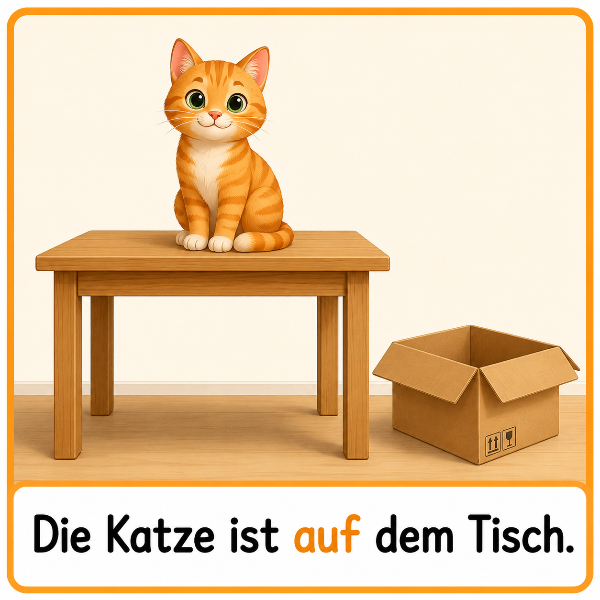
  • Stell die Tasse auf den Tisch.Put the cup on the table. (placing it there)
  • Ich gehe auf eine Konferenz.I am going to a conference.
Dativ (Wo?):
  • Die Tasse steht auf dem Tisch.The cup is on the table. (location)
  • Wir sind gerade auf einer Konferenz.We are at a conference right now.
hinter behind Akk. / Dat.
Akkusativ (Wohin?):
  • Er stellt das Fahrrad hinter das Haus.He puts the bicycle behind the house. (motion to)
Dativ (Wo?):
  • Das Fahrrad steht hinter dem Haus.The bicycle is behind the house. (location)
  • Hinter der Bühne war es chaotisch.Backstage it was chaotic.
in in · into Akk. / Dat.
Akkusativ (Wohin?):
  • Ich gehe in den Park.I am going into the park. (entering)
  • Wir fliegen in die Schweiz.We are flying to Switzerland. (countries with article)
Dativ (Wo?):
  • Ich bin im Park.I am in the park. (location)
  • Sie wohnt in der Schweiz.She lives in Switzerland.
neben next to · beside · in addition to Akk. / Dat.
Akkusativ (Wohin?):
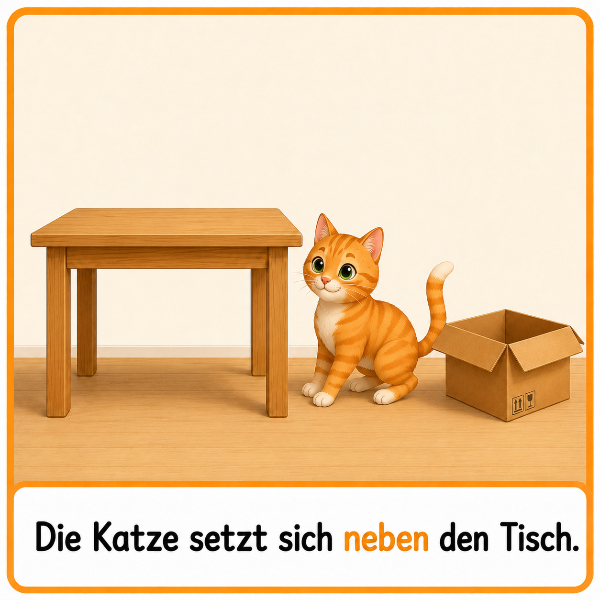
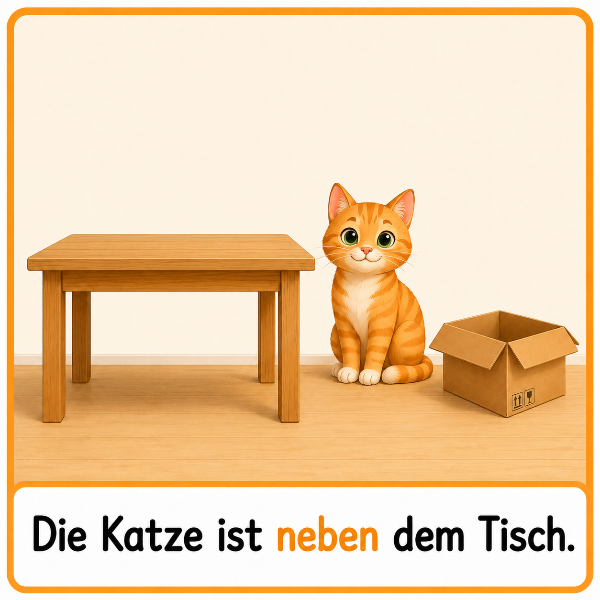
  • Setz dich neben mich!Sit down next to me! (movement to that spot)
Dativ (Wo?):
  • Sie sitzt neben ihrem Mann.She is sitting next to her husband. (location)
  • Neben seiner Arbeit studiert er Psychologie.In addition to his job he is studying psychology.
über over · above · across · about (topic) Akk. / Dat.
Akkusativ (Wohin? · also for “about”):
  • Wir gehen über die Brücke.We are walking across the bridge. (motion across)
  • Wir sprechen über das Problem.We are talking about the problem. (always Akk. with sprechen / reden / diskutieren)
Dativ (Wo?):
  • Die Lampe hängt über dem Tisch.The lamp hangs over the table. (location)
unter under · below · among Akk. / Dat.
Akkusativ (Wohin?):
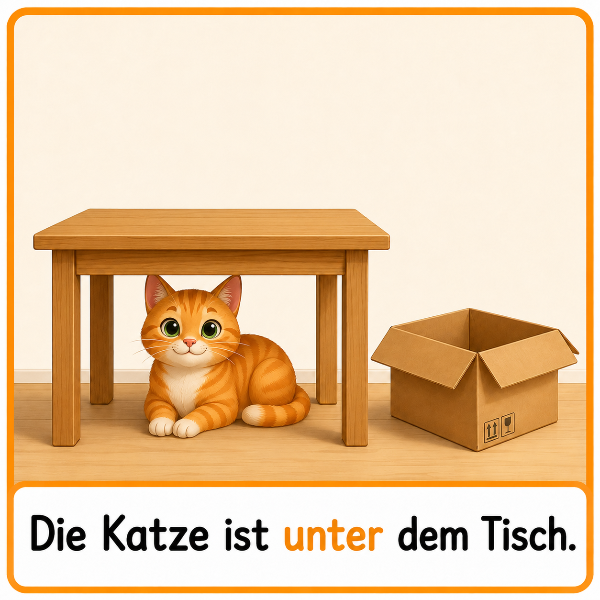
  • Die Katze kroch unter das Bett.The cat crawled under the bed. (motion to)
Dativ (Wo? · also “among”):
  • Die Katze schläft unter dem Bett.The cat is sleeping under the bed. (location)
  • Unter den Studenten ist sie sehr beliebt.Among the students she is very popular.
vor in front of · before (time) · ago Akk. / Dat.
Akkusativ (Wohin?):
  • Sie stellt das Auto vor das Haus.She parks the car in front of the house. (motion to)
Dativ (Wo? · time expressions · ago):
  • Das Auto steht vor dem Haus.The car is in front of the house. (location)
  • Ich war vor einem Jahr in Berlin.I was in Berlin a year ago. (time — always Dativ)
zwischen between Akk. / Dat.
Akkusativ (Wohin?):
  • Stell den Stuhl zwischen das Sofa und den Tisch.Put the chair between the sofa and the table. (placing)
Dativ (Wo?):
  • Der Stuhl steht zwischen dem Sofa und dem Tisch.The chair stands between the sofa and the table. (location)
  • Zwischen uns gibt es keine Geheimnisse.Between us there are no secrets. (figurative — Dativ)

How to internalise this

Three passes. First pass: read the article straight through. Do not stop to memorise — let the patterns soak in.

Second pass: for each preposition, cover the example sentences and produce one of your own about your daily life. “Ich gehe nach der Arbeit ins Fitnessstudio.” “Wegen des schlechten Wetters bleibe ich zu Hause.” Personal sentences anchor the case.

Third pass: drill only the Wechselpräpositionen. They are where most C1 candidates lose marks. Take any verb (stellen / stehen, legen / liegen, hängen / hängen, sich setzen / sitzen) and consciously practice the Wohin-Wo distinction. Ich stelle das Glas auf den Tisch. Das Glas steht auf dem Tisch. Twenty pairs and the reflex sets in.

For Sprachbausteine specifically: when you see a preposition gap, your first move is not to find the meaning — it is to identify the noun phrase that follows the gap. Look at the article (der/dem/den/des) and you already have the case. From the case, you eliminate two-thirds of the prepositions. Meaning then resolves the rest. That is the order: case first, meaning second.

FIELD MANUAL · COMPLETE
Categories
C1-Grammer C1-Vocabulary

The Detective Reference Guide( Collocations)

Reading Time: 6 minutes

https://quizlet.com/de/1178340782/detective-reference-guide-c1-flash-cards/?i=8m3rz&x=1qqt

Detective Series · The Reference Vault

50 Fixed Expressions Every C1 Candidate Must Know

Funktionsverbgefüge · Feste Präpositionalphrasen · Redewendungen

If the previous case files taught you to recognise idiomatic gaps, this dossier gives you the ammunition to solve them. Fifty expressions, organised by family, each with a model sentence and an English equivalent. Memorise these and a third of every Sprachbausteine paper becomes free points.

Three families of fixed expressions appear again and again in telc C1 — and not just in Sprachbausteine. They surface in Leseverstehen, slip into Hörverstehen as connective tissue, and impress examiners when used naturally in the Mündliche Prüfung. They are the connective sinew of educated German.

The trouble is that none of them follow logic. “Etwas in Frage stellen” takes in, not auf or zur, for no rule-based reason. “Im Großen und Ganzen” declines like that and not otherwise because it just does. Either you have memorised the phrase or you guess.

This case file is structured for repeated reference. Read it once now to see what is here. Then return to it ten times — every time you do a Sprachbausteine drill, every time one of these phrases appears in a reading, every time your German teacher uses one and you nod without quite knowing why.

Part 1 · Funktionsverbgefüge (FVG) 20 entries

A Funktionsverbgefüge (“function-verb construction”) replaces a single verb with a noun-plus-light-verb combination. Instead of “entscheiden” you say “eine Entscheidung treffen”. The noun carries the meaning, the verb is a near-empty placeholder. FVGs sound formal, literary, and very C1 — examiners love them. They are also the single most testable construction in Sprachbausteine because the preposition or article in front of the noun is a perfect gap.
FunktionsverbgefügeMeaning · Equivalent verb
1zur Verfügung stellento make available · bereitstellen
2in Betracht ziehento take into consideration · berücksichtigen, erwägen
3in Frage stellento call into question · bezweifeln
4in Kraft tretento come into force · gültig werden
5in Kraft setzento enact, put into force · erlassen
6eine Entscheidung treffento make a decision · entscheiden
7eine Frage stellento ask a question · fragen
8eine Rolle spielento play a role / matter · wichtig sein
9in Anspruch nehmento make use of, claim · nutzen, beanspruchen
10zur Sprache bringento bring up (a topic) · thematisieren
11zum Ausdruck bringento express · ausdrücken
12in Erfüllung gehento be fulfilled (of wishes) · sich erfüllen
13unter Druck setzento put under pressure · bedrängen
14zum Einsatz kommento be deployed / used · eingesetzt werden
15in Auftrag gebento commission · beauftragen
16Abschied nehmen (von)to say goodbye (to) · sich verabschieden
17Bezug nehmen (auf)to refer (to) · sich beziehen auf
18in Verbindung treten (mit)to get in contact (with) · kontaktieren
19zur Folge habento result in · verursachen, bewirken
20in Erwägung ziehento consider, weigh up · erwägen

Five FVGs in action

Die Universität stellt den Studierenden moderne Computerräume zur Verfügung.
The university makes modern computer rooms available to its students.
Bevor wir entscheiden, müssen wir alle Alternativen in Betracht ziehen.
Before we decide, we must take all alternatives into consideration.
Das neue Gesetz tritt am 1. Januar in Kraft.
The new law comes into force on the 1st of January.
Die Klimakrise spielt in dieser Debatte eine zentrale Rolle.
The climate crisis plays a central role in this debate.
Viele Eltern nehmen die staatliche Beratung in Anspruch.
Many parents make use of the state advisory service.
Sprachbausteine pattern: the gap is almost always the preposition in front of the noun (in, zur, zum, unter, außer) — never the noun itself. Train yourself to recognise the noun-plus-verb skeleton (“Verfügung … stellen”) and the gap snaps into focus.

Part 2 · Feste Präpositionalphrasen 20 entries

Fixed prepositional phrases are short, frozen combinations of a preposition and a noun (often without an article) that function as an adverb or modifier. “Auf Probe” means “on a trial basis” — you cannot say “in Probe” or “zur Probe”. The phrase is welded together. These appear constantly in formal German and almost always show up as Sprachbausteine gaps.
PhraseMeaning
21auf Probeon a trial basis, probationary
22im Großen und Ganzenon the whole, by and large
23in der Regelas a rule, usually
24im Gegenteilon the contrary
25im Gegensatz zuin contrast to
26im Vergleich zucompared to
27im Hinblick aufwith regard to, in view of
28in Bezug aufwith reference to, regarding
29unter Umständenpossibly, under certain circumstances
30auf jeden Fallin any case, definitely
31auf keinen Fallon no account, definitely not
32in der Tatindeed, in fact
33aus diesem Grundfor this reason
34vor allemabove all, especially
35zum einen … zum anderenon the one hand … on the other
36auf den ersten Blickat first glance
37auf lange Sichtin the long run
38in der Lage sein (zu)to be in a position (to), able (to)
39aus Versehenby accident, inadvertently
40unter vier Augenin private, just between us

Five fixed phrases in action

Sie wurde zunächst auf Probe eingestellt; nach sechs Monaten erhielt sie einen festen Vertrag.
She was initially hired on a trial basis; after six months she received a permanent contract.
Im Großen und Ganzen bin ich mit der Entscheidung zufrieden, auch wenn einige Details verbesserungswürdig sind.
On the whole, I am satisfied with the decision, even if some details could be improved.
Im Hinblick auf die wirtschaftliche Lage müssen wir vorsichtig planen.
In view of the economic situation, we must plan carefully.
Sein Verhalten hat mich nicht enttäuscht — im Gegenteil, ich war beeindruckt.
His behaviour did not disappoint me — on the contrary, I was impressed.
Das Unternehmen ist nicht in der Lage, die Lieferfristen einzuhalten.
The company is not in a position to meet the delivery deadlines.
Sprachbausteine pattern: the gap usually lands either on the preposition (im, in, auf, unter, vor) or on the article-fragment fused to it (im = in dem, zur = zu der). Notice that most of these phrases have no separate article in front of the noun — that bare-noun signature is itself a recognition cue.

Part 3 · Redewendungen 10 entries

Idioms are the highest-risk, highest-reward category. They never appear with their literal meaning intact. “Den Nagel auf den Kopf treffen” has nothing to do with hammers — it means “to hit the nail on the head”. You will not deduce these. You learn them, you recognise them, you deploy them. Use one or two of these in the Mündliche Prüfung and your examiner will mentally upgrade you half a band.
IdiomMeaning
41den Nagel auf den Kopf treffento hit the nail on the head
42aus dem Ruder laufento get out of hand, spiral out of control
43unter den Tisch fallento be ignored, slip through the cracks
44im Großen und Ganzen funktionierento work in essence, broadly speaking
45jemandem unter die Arme greifento lend someone a hand, help out
46auf der Hand liegento be obvious, self-evident
47jemandem einen Strich durch die Rechnung machento thwart someone’s plans
48die Daumen drückento keep one’s fingers crossed
49ins Auge fassento consider, contemplate (a plan)
50über den Tellerrand schauento think outside the box, broaden one’s horizon

Five idioms in action

Mit deiner Analyse hast du den Nagel auf den Kopf getroffen — genau das ist das Problem.
With your analysis you hit the nail on the head — that is exactly the problem.
Wenn wir nicht eingreifen, wird das Projekt aus dem Ruder laufen.
If we do not intervene, the project will get out of hand.
Die Sicherheitsbedenken dürfen nicht unter den Tisch fallen.
The safety concerns must not be swept aside.
Dass die Digitalisierung Arbeitsplätze verändert, liegt auf der Hand.
That digitalisation is changing jobs is self-evident.
Als Führungskraft muss man manchmal über den Tellerrand schauen, um neue Lösungen zu finden.
As a leader, one sometimes has to think outside the box to find new solutions.

How to actually learn these

Fifty entries in one sitting is not a learning plan — it is a list. Here is the protocol that works:

Week one: Read the entire dossier once. Mark with a pen the ones you have never seen before. Do not try to memorise; just acquaint your eye.

Week two: Take ten entries per day. For each, write one sentence of your own — about your work, your week, your German learning. Five sentences per day, fifty by week’s end. Personal context anchors the phrase to memory.

Week three onward: Drill in mixed Sprachbausteine practice. When one of these appears in a real exam paper, you will recognise the skeleton (“Verfügung stellen”, “Probe”, “Tellerrand”) and the missing preposition will be obvious.

Bonus drill: In the Mündliche Prüfung, plant two idioms and three FVGs into your Präsentation. Phrases like “in Betracht ziehen”, “eine zentrale Rolle spielen”, “im Großen und Ganzen”, “auf der Hand liegen”, and “über den Tellerrand schauen” sound natural in any opinion piece. Your examiner will hear them and tick the C1-vocabulary box without further deliberation.

The honest reality: nobody learns 50 expressions in one week. Aim for 10 mastered, 20 recognised, 20 vaguely familiar by exam day. That is enough to handle every fixed-phrase gap in the Sprachbausteine and to spike your Mündliche performance. Total domination is a goal for after the exam, not before it.

REFERENCE · VAULT
Categories
C1-Grammer

Detective Guide Sprachbausteine 5/5

Reading Time: 9 minutes
German Tadka · Detective Series II · Final Episode
Case File №5 · Sprachbausteine for telc C1

The Educated Guess & the Final Showdown

In which Detective Tadka, the case folder closing, reveals the betting heuristics for when nothing is certain — and then walks live through a full 22-gap Sprachbausteine, applying every technique from the entire investigation.
“There comes a moment in every Sprachbausteine,” said the Detective, “when the grammar is silent, the lexicon is unfamiliar, and all four options sit in the lineup wearing the same mask. You will have one minute. You must commit. To leave a gap empty is to volunteer for a zero. So today I teach you how to bet — not blindly, but with the cunning of a man who has read a thousand exams. Then we will close the file. One full text. Twenty-two gaps. Every technique we have ever learned, applied in real time. After this, you are no longer a candidate. You are a detective.”

Part 1 — The Six Betting Heuristics

When all six elimination tests fail to clear the field, you bet. These six heuristics are not infallible. They are statistically biased toward correct on telc C1 papers — meaning, in aggregate, applying them across uncertain gaps will lift your score by 1–3 points.

Heuristic 1 — Bet on the C1 Word

If two options remain and one is B1-comfortable while the other is C1-formal, the C1 word usually wins. The exam tests precision and register.

B1-comfortable (lose)C1-formal (win)
aberjedoch, allerdings, hingegen
weilda, aufgrund (+Gen)
auchzudem, ferner, darüber hinaus
alsosomit, folglich, infolgedessen
nurlediglich, ausschließlich
am Endeletztendlich, schließlich
denkenerachten, betrachten als
SacheAngelegenheit, Sachverhalt

Heuristic 2 — Bet on the Genitiv

When forced to choose a preposition before der/des/eines + Genitiv-marked noun, the formal Genitiv-governing prepositions (aufgrund, infolge, angesichts, hinsichtlich, mittels, anhand) are statistically favoured over the colloquial wegen + Dativ.

Heuristic 3 — Bet on the Less Obvious Connector

If you find yourself thinking “this could be either aber or jedoch” — the answer is jedoch. If you think “either weil or da” — the answer is da. The exam writers know the obvious choice and engineer the question to reward the precise one.

Heuristic 4 — Bet on the Fixed Phrase

If one option creates a recognised set phrase (in Anspruch nehmen, zur Verfügung stellen, in Frage stellen, eine Rolle spielen) and the others do not, bet on the fixed phrase. The exam loves Funktionsverbgefüge because they cannot be deduced.

Funktionsverbgefüge to Recognise on Sight
in Frage stellen, in Anspruch nehmen, zur Verfügung stellen, eine Rolle spielen, in Kraft treten, zur Sprache bringen, in Betracht kommen, zur Diskussion stehen, in Erwägung ziehen, in Anspruch nehmen, Bezug nehmen auf, Rücksicht nehmen auf, zum Ausdruck bringen, ins Leben rufen, unter Beweis stellen, in Aussicht stellen, in Verbindung bringen mit, einen Beitrag leisten zu, eine Entscheidung treffen, Kritik üben an

Heuristic 5 — Bet on the Reflexive

If sich appears anywhere in the surrounding sentence and three options have a “physical” preposition while one has a “psychological” one (auf, an, über, mit), the psychological one is usually the verb-prep collocation.

Heuristic 6 — Bet on Parallel Structure

If the sentence shows nicht nur … sondern auch, einerseits … andererseits, zwar … aber, je … desto, the gap is almost always the second half of the pair. Recognising the opening half locks the answer.

If you see…The gap is…
nicht nur …sondern auch
einerseits …andererseits
zwar …aber / jedoch
je + Komparativ …desto / umso + Komparativ
weder …noch
entweder …oder
sowohl …als auch
so + Adj …wie
“The educated guess is not luck. It is informed probability.”

Part 2 — Time Management on the Day

You have 20 minutes for the entire Sprachbausteine block (within the 90-minute Lesen+Sprachbausteine slot). That is 55 seconds per gap, including reading the surrounding sentence. The discipline:

1First pass — 12 minutes: answer every gap you can solve in under 30 seconds. Skip the rest.
2Second pass — 5 minutes: return to the skipped gaps. Apply elimination tests. Commit answers even when uncertain.
3Third pass — 3 minutes: for any remaining gaps, apply the betting heuristics. Never leave a gap empty. A guessed answer has a 25% chance of being right; an empty answer has 0%.
Do not transfer answers to the answer sheet at the end — transfer continuously, gap by gap, as you solve. Candidates lose 2–3 points every year by running out of time during transfer.

Part 3 — The Final Showdown: A Full 22-Gap Sprachbausteine

This is the closing case of the entire series. A typical telc C1 text on the digitalisation of the workplace, with 22 gaps. Read it through once. Then attempt each gap before reading the answer.

The Text — “Arbeit im digitalen Zeitalter”

Die Arbeitswelt befindet sich in einem tiefgreifenden Wandel. 1 der zunehmenden Digitalisierung verändern sich nicht nur die Werkzeuge, mit 2 wir arbeiten, sondern auch die Strukturen, in denen wir tätig sind. Viele Unternehmen 3 sich seit Jahren mit der Frage, wie sie ihre Belegschaft optimal auf diese Veränderungen vorbereiten können.

Eine kürzlich veröffentlichte Studie des Instituts für Arbeitsmarktforschung kam zu dem Ergebnis, dass 4 60 Prozent der Beschäftigten in den nächsten zehn Jahren mit erheblichen Veränderungen ihres Tätigkeitsfeldes rechnen müssen. 5 der hohen Anpassungsbereitschaft vieler Mitarbeiter gibt es jedoch auch Sorgen: Was passiert mit jenen, 6 Qualifikationen nicht mehr gefragt sind?

Die Politik hat 7 begonnen, auf diese Herausforderung zu reagieren. 8 wurden in den letzten Jahren zahlreiche Förderprogramme ins Leben gerufen, die Weiterbildung erleichtern sollen. 9 Programme richten sich besonders an Berufstätige, die ihre digitalen Kompetenzen ausbauen möchten.

10 Experten warnen jedoch davor, sich allein auf staatliche Maßnahmen zu verlassen. „Die Verantwortung für lebenslanges Lernen liegt 11 beim Einzelnen”, betonte die Arbeitsmarktforscherin Dr. Hahn in einem Interview. Sie fügte 12, dass der Arbeitsmarkt in zehn Jahren ein anderer sein werde.

Besonders kleinere Unternehmen sehen sich 13 erheblichen Schwierigkeiten konfrontiert. 14 sie nicht über die Ressourcen großer Konzerne verfügen, fehlt ihnen oft das Budget für umfassende Schulungen. 15 bietet die zunehmende Verfügbarkeit kostenloser Online-Kurse hier eine Chance, die früher undenkbar gewesen 16.

Auch der Wandel der Unternehmenskultur spielt eine wichtige Rolle. Während früher klare Hierarchien dominierten, 17 heute flexible Teamstrukturen bevorzugt. Mitarbeiter werden nicht mehr nur als Ausführende betrachtet, 18 als Mitgestalter des Wandels.

Es bleibt offen, ob die Geschwindigkeit der Veränderungen aufrechterhalten werden 19. Klar ist aber, dass diejenigen, die sich frühzeitig anpassen, langfristig profitieren werden. Wer hingegen die Entwicklung 20 Auge verliert, riskiert den Anschluss zu verlieren.

21 hingewiesen werden sollte, ist die Tatsache, dass nicht nur technische Fähigkeiten zählen. Soziale Kompetenzen, Empathie und kritisches Denken werden 22 wichtiger — gerade in einer Welt, in der Maschinen viele Routinetätigkeiten übernehmen.

The Options

#abcd
1WegenAufgrundWährendMittels
2welchendenenderwas
3befassendenkenfragenbeschäftigen
4annäherndgegenüberetwaweniger
5WegenTrotzAufgrundMit
6derendenendessendie
7kauminzwischennoch nichtnie
8DaherWeilObwohlFalls
9DieseJeneWelcheSolche
10MancheWenigeKeineNiemand
11letztendlichsicherlichvielleichtmöglicherweise
12hinnachhinzuzu
13mitzuvongegen
14WeilDaWennOb
15TrotzdemDennochAllerdingsFolglich
16wärehättewürdeist
17werdensindwordengewesen
18aberdochsondernjedoch
19kannkönntewirdsoll
20vomaus demimaus den
21WoraufWomitWorüberWovon
22immerständignochschon

The Solved Walkthrough — Detective’s Reasoning

Gap 1 — Aufgrund (b). Sentence-start + Genitiv (der … Digitalisierung) + main clause. Während would need a verb-clause. Mittels = “by means of” — instrumental, wrong. Wegen works grammatically but aufgrund is the C1-register choice (Heuristic 1).
Gap 2 — denen (b). Relative pronoun. Bezugswort = Werkzeuge (plural). Inside the relative clause: arbeiten mit + Dat. Plural Dativ relative pronoun → denen. welchen is rare/archaic; was only refers to indefinites; der is wrong gender/number.
Gap 3 — beschäftigen (d). sich beschäftigen mit + Dat = engage with, address. befassen would also work syntactically (sich befassen mit) but is less frequent and the option here is the unreflexive form. denken takes an; fragen takes nach. The reflexive sich already in the sentence locks the verb.
Gap 4 — etwa (c). “_____ 60 Prozent” = “approximately 60 percent.” etwa is the standard quantifier. annähernd works but is less idiomatic in this position. gegenüber = “compared to” — wrong meaning. weniger = “less than” — would need als.
Gap 5 — Trotz (b). Genitiv preposition + concessive logic. The sentence sets up a contrast: high willingness but there are also worries. Trotz + Gen captures this. Wegen / Aufgrund = causal, wrong. Mit takes Dativ, also wrong logic.
Gap 6 — deren (a). Relative pronoun. Bezugswort = jenen (plural — those people). Inside the clause: Qualifikationen belongs to them → possessive → Genitiv. Plural Genitiv → deren. dessen is masc/neut singular; denen is Dativ; die is Nom/Akk.
Gap 7 — inzwischen (b). “The politics has _____ begun to react.” Logically, the political response is now underway. kaum = “barely” — contradicts the rest of the paragraph. noch nicht = “not yet” — same problem. nie = “never” — same problem. inzwischen = “in the meantime, by now” — fits.
Gap 8 — Daher (a). Sentence-start + verb in position 2 (wurden). Weil, Obwohl, Falls all force verb-final → dead. Daher = consequential adverb at position 1 → verb stays at 2. Logic: politics started reacting → therefore programs were created.
Gap 9 — Diese (a). Anaphoric reference back to the Förderprogramme just mentioned. Diese = “these (just-mentioned)” is the standard anaphoric demonstrative. Jene = “those” (more remote, archaic in this context). Welche = interrogative or relative. Solche = “such” (qualitative, not anaphoric).
Gap 10 — Manche (a). Subject + verb (warnen) in plural. Wenige = “few” works grammatically but the rest of the paragraph supports a substantial body of opinion. Keine = “no experts” — contradicts. Niemand is singular. Manche = “some” — fits the journalistic register.
Gap 11 — letztendlich (a). Adverb of conclusion: “ultimately the responsibility lies with the individual.” sicherlich, vielleicht, möglicherweise all express probability — but the sentence makes a definite assertion. letztendlich = “ultimately, in the end” — the conclusive force the sentence requires (Heuristic 1: C1-register over B1).
Gap 12 — hinzu (c). hinzufügen = “to add” (a separable verb meaning “to add to what was just said”). Sie fügte hinzu, dass … is a fixed reporting phrase. hin / nach / zu alone do not form this collocation.
Gap 13 — mit (a). sich konfrontiert sehen mit + Dat = “to find oneself confronted with.” Fixed collocation. erheblichen Schwierigkeiten is Dativ Plural — confirms mit. The other prepositions break the collocation.
Gap 14 — Da (b). Subordinator with verb-final clause (verfügen at the end). The relationship is causal. Weil would also fit but da is the formal C1-register causal subordinator (Heuristic 3 — bet on the less obvious). Wenn = conditional, Ob = whether (indirect question).
Gap 15 — Allerdings (c). Sentence-start + verb in position 2 (bietet). Folglich = consequence — wrong logic (the sentence pivots to a positive contrast). Trotzdem / Dennoch are also concessive but allerdings is the C1-typical “however / though” that softly introduces a counterpoint after a problem statement.
Gap 16 — wäre (a). Konjunktiv II Vergangenheit Passiv: undenkbar gewesen wäre = “would have been unthinkable.” The auxiliary is sein because sein + adjective + gewesen uses sein. hätte is wrong auxiliary; würde would shift to present; ist is indicative.
Gap 17 — werden (a). Vorgangspassiv Präsens: “today flexible team structures are preferred.” werden + Partizip II (bevorzugt). sind bevorzugt would be Zustandspassiv but emphasises state, not the ongoing change the text describes. worden / gewesen are wrong tense.
Gap 18 — sondern (c). The pattern is nicht … als …, sondern als … — a correction structure after negation. aber, doch, jedoch are contrast, not correction. The negation nicht mehr nur in clause 1 + alternative in clause 2 = sondern.
Gap 19 — kann (a). “Whether the speed of change can be sustained.” Indicative present + Modalverb + Passivinfinitiv (aufrechterhalten werden). könnte would shift to Konjunktiv II (hypothetical) — possible but kann matches the surrounding indicative tone of the article. wird is Futur Passiv — wrong structure. soll = “is supposed to” — wrong meaning.
Gap 20 — aus dem (b). Fixed phrase: etwas aus dem Auge verlieren = “to lose sight of something.” Idiom. The other options break the collocation.
Gap 21 — Worauf (a). Wo-compound functioning as connector: “What should also be pointed out is …” → Worauf hingewiesen werden sollte. The verb hinweisen auf + Akk dictates the preposition. Womit / Worüber / Wovon all fit other verbs but not hinweisen.
Gap 22 — immer (a). The construction immer + Komparativ = “ever more, increasingly.” immer wichtiger = “ever more important.” noch / schon / ständig do not combine with comparatives in this way (ständig means “constantly” but does not pair with comparatives).

Summary — The Six-Step Detective Method, Crystallised

Every Sprachbausteine question, no matter how disguised, yields to this method:

1Scan the gap. What stands before? What stands after? What is the verb position?
2Classify the family. Grammatical / Logical / Lexical / Idiomatic.
3Interrogate grammar. Case, gender, article type, tense, mood.
4Eliminate. Position test, case test, tense test, logic test, collocation test, register test.
5If two survive — bet. C1 over B1, less obvious over obvious, fixed phrase over free phrase.
6Commit. Never leave a gap empty. Move on. Trust the next gap.
“You are no longer guessing. You are deducing.”

Vocabulary Table — Case File №5

GermanEnglishNote
der Wandelchange, transformationsingular only; cf. die Veränderung (concrete change)
das Werkzeug, -etoolliteral and metaphorical
die Belegschaft, -enworkforce, staffcollective noun for employees of one company
die Arbeitsmarktforschunglabour-market researchcompound: Arbeit + Markt + Forschung
der Beschäftigte, -nemployed personadjectival noun; declines like adjective
das Tätigkeitsfeld, -erfield of activitycompound: Tätigkeit + Feld
die Anpassungsbereitschaftwillingness to adaptsingular abstract; high-frequency C1
die Qualifikation, -enqualificationoften plural; Qualifikationen erwerben
die Herausforderung, -enchallengevor einer Herausforderung stehen
das Förderprogramm, -esupport / funding programmeein Programm ins Leben rufen
die Weiterbildung, -enfurther trainingplural exists but rare
die Verantwortung, -enresponsibilityVerantwortung tragen / übernehmen
der Konzern, -ecorporationlarge company; cf. das Unternehmen (any business)
die Schulung, -entraining sessionconcrete; cf. Weiterbildung (broader)
die Verfügbarkeitavailabilitysingular abstract
die Hierarchie, -nhierarchyoften plural in organisational contexts
der Mitgestalter, –co-creator, shaperfem. = die Mitgestalterin
der Anschlussconnection, contactden Anschluss verlieren = to fall behind
die Routinetätigkeit, -enroutine activityoften plural
tiefgreifendprofound, far-reachingtypical C1 adjective for change
aufrechterhaltento sustain, maintainseparable; hielt aufrecht — aufrechterhalten
hinweisen auf + Akkto point out, refer toseparable; verb-prep collocation
aus dem Auge verlierento lose sight ofidiom; takes Akkusativ object
immer + Komparativincreasinglyfixed intensifier; immer wichtiger / besser / häufiger
CASE №5 · CLOSED
SERIES · COMPLETE
“Twenty-two gaps,” said the Detective, snapping shut the folder. “Twenty-two suspects, and not one of them has escaped. You have learned to read the gap before the options. To interrogate grammar before lexicon. To eliminate before you choose. And when nothing else works — to bet with the cunning of an investigator who has read the file before. The exam will come. You are ready. Auf Wiedersehen, mein Freund.

— End of Detective Series II: Sprachbausteine for telc C1 —
Categories
C1-Grammer

Detective Guide Sprachbausteine 4/5

Reading Time: 6 minutes
German Tadka · Detective Series II
Case File №4 · Sprachbausteine for telc C1

The Elimination Protocol

In which Detective Tadka demonstrates that the path to the right answer almost always runs through the corpses of the wrong ones — and that knocking out two of four options reliably is worth more than recognising one of four perfectly.
“Listen carefully,” said the Detective, “because this is the hardest lesson the amateur ever learns. You will not always know the right answer. You can always know two of the wrong ones. Eliminate two of four — and your odds rise from 25% to 50%. Eliminate three of four — and you have a near-certain answer without ever having seen the correct option clearly. The protocol of elimination is not a backup strategy. It is the primary strategy. Even when you know the answer, you must still verify by killing the other three.”

The Six Elimination Tests

Run these in order on every Sprachbausteine question. Each test kills options that fail it.

1The Position Test — does the option fit the syntactic slot? (verb-final connector in a verb-2 slot? → dead.)
2The Case Test — does the case the option requires match the case the surrounding noun phrase shows?
3The Tense Test — does the verb form align with the tense and mood of the surrounding clause?
4The Logic Test — does the meaning fit the logical relationship between the clauses?
5The Collocation Test — is this option ever found in fixed pairing with the verb / noun / preposition next to it?
6The Register Test — does the option’s formality match the register of the text (academic, journalistic, narrative)?
“Wrong answers leave fingerprints. Find one fingerprint, and the suspect is gone.”

Test 1 — The Position Test

The fastest killer of options. Every connector belongs to one of three syntactic classes:

ClassVerb PositionMembers
Coordinator (Pos. 0)verb stays at 2 in clause 2aber, denn, doch, oder, sondern, und
Conjunctional adverb (Pos. 1)verb inverts to 2 after the adverbdennoch, trotzdem, jedoch, deshalb, daher, somit, folglich, hingegen, allerdings
Subordinatorverb at the enddass, weil, obwohl, wenn, als, nachdem, sobald, sofern, falls, während, indem, damit

Position-Based Elimination Example

Die Forscher arbeiteten jahrelang an dem Projekt, _____ veröffentlichten sie ihre Ergebnisse. The researchers worked on the project for years; _____ they published their results.
a) weil b) schließlich c) obwohl d) dass
Position kill: the second clause shows verb in position 2 (veröffentlichten sie — verb-subject inversion). This means weil, obwohl, dass are all dead immediately — they would force verb-final order. Only schließlich (a conjunctional adverb at position 1) survives. Answer locked without consulting meaning.

Test 2 — The Case Test

If a noun phrase is visibly Akkusativ (e.g. den Mann), then any preposition that demands Dativ (e.g. mit) is dead. The case shown by article and adjective endings is forensic evidence.

Case-Based Elimination Example

Der Bericht enthält Informationen _____ den aktuellen Stand der Forschung.
a) von b) über c) mit d) bei
Case kill: den aktuellen Stand = Akkusativ masc. von, mit, bei all demand Dativ → dead on sight. Only über (Wechselpräposition + Akk. for “about”) survives. Even without knowing the collocation, the case ending settles the question.

Test 3 — The Tense Test

Tenses must agree across the surrounding clause. The presence of hätte / wäre + Partizip II demands Konjunktiv II. The presence of nachdem demands a tense shift. The presence of an indirekte Rede frame demands Konjunktiv I.

Tense-Based Elimination Example

Hätte das Unternehmen die Warnungen ernst genommen, _____ der Skandal verhindert werden können.
a) wäre b) würde c) hätte d) hat
Tense kill: Konjunktiv II Vergangenheit Passiv with Modalverb. verhindern uses haben. würde implies present-tense Konj. II — wrong tense. hat = Indikativ — wrong mood. wäre would only work if the main verb used sein. Only hätte survives.

Test 4 — The Logic Test

The relationship between the clauses must be coherent. Does clause 2 confirm, contradict, qualify, cause, or follow from clause 1? Each connector encodes a different relationship — check that the relationship in the text matches the connector you choose.

Logical RelationshipLikely Connectors
Concession (X true, but Y also true)obwohl, trotz, trotzdem, dennoch, allerdings, zwar … aber
Contrast (X vs. Y, parallel)während, hingegen, dagegen, demgegenüber
Causeweil, da, denn, aufgrund, wegen
Consequencedeshalb, daher, somit, folglich, infolgedessen
Purposedamit, um … zu
Time (sequence)nachdem, bevor, sobald, als, während
Conditionwenn, falls, sofern, sollte (inverted)
Means / howindem, dadurch, dass

Logic-Based Elimination Example

Während Hunde meist gerne Gesellschaft suchen, _____ Katzen ihre Unabhängigkeit. While dogs usually seek company, cats _____ their independence.
a) verlieren b) bevorzugen c) ablehnen d) fürchten
Logic kill: während here is contrastive. Clause 1 = “dogs seek company.” Clause 2 must be the parallel opposite for cats: “cats prefer independence.” verlieren (lose) breaks the parallel. ablehnen (reject) is too strong. fürchten (fear) makes no sense. Only bevorzugen (prefer) keeps the parallel.

Test 5 — The Collocation Test

Some verbs and nouns “want” only one preposition. If you know the collocation, three options die instantly. If you don’t, you can still kill the obvious mismatches.

The Collocation Heuristic

When in Doubt about a Verb-Preposition Pair
Default to auf with reflexive psychological verbs (sich freuen auf, sich konzentrieren auf, sich verlassen auf, achten auf, warten auf, hoffen auf). Default to mit with active engagement verbs (sich beschäftigen mit, umgehen mit, rechnen mit). Default to an with verbs of memory and attachment (denken an, sich erinnern an, sich gewöhnen an). These three families cover 70% of C1 verb-preposition gaps.

Test 6 — The Register Test

The Sprachbausteine text is consistently formal: journalistic, scientific, or essayistic. Options that are colloquial almost always lose.

Colloquial / spokenFormal / C1-typical
weilda, aufgrund
wegen + Dativwegen + Genitiv, aufgrund + Genitiv
kriegenerhalten, bekommen
okay / okeinverstanden, in Ordnung
ja / mal / halt (Modalpartikel)(usually absent in formal text)
so dasssodass / mit der Folge, dass
nurlediglich, ausschließlich

The 50-50 Strategy

When two options survive all six tests, you have a 50-50. At that point, three tactical heuristics tilt the odds:

1The “More Specific” Rule: when in doubt between a generic and a specific connector, the specific one is more often correct (aufgrund beats wegen; infolgedessen beats also). The exam tests precision.
2The “Less Common” Rule: the option you would not have chosen as a B2 student is often the C1 answer. jedoch over aber. indem over weil. dennoch over aber. The Sprachbausteine rewards C1-register vocabulary, not B1-comfort.
3The “Sentence-as-Whole” Rule: read the full sentence aloud (or silently) with each survivor inserted. The wrong one usually sounds wrong by intonation, even if you cannot articulate why. Trust your ear at C1.

Worked Walkthrough — A Full Elimination

Viele junge Erwachsene leben heute länger bei ihren Eltern, _____ aus finanziellen als aus emotionalen Gründen. Many young adults today live longer with their parents — _____ for financial than for emotional reasons.
a) weil b) zwar c) eher d) sondern

Test 1 (Position): the surrounding structure is “_____ aus X als aus Y” — a comparative phrase. weil would demand a verb-final clause to follow; here the slot is followed by “aus finanziellen Gründen“, a noun phrase. weil dies.

Test 4 (Logic): the structure “X als Y” is a comparison. zwar opens a concession waiting for “aber” — there is no “aber” to follow. zwar dies. sondern requires negation in clause 1 (nicht … sondern) — there is no negation. sondern dies.

Survivor: eher (“rather, more”) fits the comparative construction eher … als … (“more X than Y”). Answer: eher. ✓

“Three options dead. One survivor. No guessing required.”

Solved Exercise — Refresher

Gap 1

Die Demonstration verlief friedlich, _____ es im Vorfeld zahlreiche Befürchtungen gegeben hatte.
a) weil b) obwohl c) damit d) trotzdem

Eliminations: verb-final structure (gegeben hatte) → trotzdem dies (it inverts, doesn’t subordinate). weil would mean fears caused the peace — illogical. damit = purpose, no sense here. obwohl fits both syntax (verb-final) and concessive logic. ✓

Gap 2

Der Mitarbeiter hat sich noch nicht _____ die Arbeitsbedingungen gewöhnt.
a) auf b) an c) für d) mit

Eliminations: sich gewöhnen demands an + Akk. The accusative die Arbeitsbedingungen matches. auf would suggest sich freuen / sich verlassen / sich konzentrieren. mit kills any verb-prep collocation here.

Gap 3

Es regnete in Strömen; _____ entschieden wir uns, den Ausflug abzusagen.
a) weil b) obwohl c) daher d) dass

Eliminations: verb in position 2 (entschieden wir — inversion). weil, obwohl, dass all force verb-final → dead. daher (conjunctional adverb, position 1, then verb) survives and matches the consequence logic.

Gap 4

Die Studie zeigt, dass die Maßnahmen _____ effektiver waren als erwartet.
a) sehr b) deutlich c) viel mehr d) genug

Eliminations: sehr doesn’t intensify a comparative. viel mehr redundantly intensifies but doesn’t combine with als erwartet. genug means “enough,” wrong meaning. deutlich + comparative + als is the C1-register intensifier. ✓ (Compare: wesentlich, erheblich, weitaus — these are alternatives.)

Gap 5

_____ der zunehmenden Digitalisierung wird die Bedeutung sozialer Kompetenzen oft unterschätzt.
a) Dank b) Angesichts c) Wegen d) Mittels

Eliminations: Dank = “thanks to” → positive, doesn’t fit “underestimated.” Wegen = “because of” → too generic and would imply digitalisation causes the underestimation, which is logically backwards. Mittels = “by means of” → instrumental, wrong family. Angesichts = “in view of, given” → introduces a context against which the surprising main fact stands out. ✓ Register: Angesichts is the C1-typical formal preposition for this exact context.

Vocabulary Table — Case File №4

GermanEnglishNote
der Forscher, –researcherfem. = die Forscherin
das Ergebnis, -seresult, findingplural ends in -se; die Ergebnisse veröffentlichen
der Standstate, statusder aktuelle Stand der Forschung
die Forschung, -enresearchoften singular as collective noun
die Warnung, -enwarningeine Warnung aussprechen / ernst nehmen
der Skandal, -escandaleinen Skandal verhindern / aufdecken
die Demonstration, -endemonstration, protesteine Demonstration verläuft friedlich
die Befürchtung, -enfear, apprehensionalmost always plural; cf. die Furcht (singular abstract)
das Vorfeldrun-up, preliminary stageim Vorfeld = “in the run-up to”
der Mitarbeiter, –employeefem. = die Mitarbeiterin
die Arbeitsbedingung, -enworking conditionnearly always plural
der Ausflug, -¨eexcursion, outingeinen Ausflug machen / absagen
die Maßnahme, -nmeasure, actioneine Maßnahme ergreifen / treffen
die Bedeutung, -enmeaning, importancevon Bedeutung sein, an Bedeutung gewinnen
die Kompetenz, -encompetence, skillsoziale / sprachliche / interkulturelle Kompetenz
die Digitalisierungdigitalisationsingular abstract; high-frequency C1 noun
verlaufento proceed, go (of events)strong verb; uses sein
verhindernto preventweak verb; takes Akkusativ object
unterschätzento underestimateopposite: überschätzen
angesichts + Genitivin view of, givenformal C1 preposition
eher … als …more … than …comparative correlation
deutlichclearly, markedlyalso intensifier with comparatives
CASE №4 · CLOSED

Final installment: Case File №5 — The Educated Guess & Final Showdown. The Detective reveals the betting strategies for when nothing else works — and closes the series with a 22-gap full-text Sprachbausteine, solved live, applying every technique from the entire investigation.

Categories
C1-Grammer

Detective Guide Sprachbausteine 3/5

Reading Time: 6 minutes
German Tadka · Detective Series II
Case File №3 · Sprachbausteine for telc C1

The Lexical Lineup

In which Detective Tadka confronts a parade of four nearly identical suspects — connectors that all mean “but,” prepositions that all sound right, and the verb-preposition pairs that have fooled every previous candidate.
“This is where the Sprachbausteine becomes wicked,” said the Detective, narrowing his eyes. “Grammar will not save you here. All four options fit the slot. All four parse. The question is which one fits the logic — the relationship between the clauses, the precise shade of meaning, the fixed pair the language has frozen in place. To solve these, you must learn the families. aber and sondern are cousins, not twins. obwohl and trotzdem wear the same coat but stand on opposite sides of the comma. warten auf and warten gegen — only one is German. The lexical lineup rewards memory, not deduction. Come, let us drill the families.”

Family A — Adversative Connectors (the “but” Family)

Six common items, four traps. The exam loves to give you all four in one question.

ConnectorTypeWord Order AfterUse
abercoordinatingposition 0 — verb stays at 2simple contrast: X, aber Y.
dochcoordinating / particleposition 0 OR Mittelfeldstronger contrast, often emphatic
jedochconjunctional adverbposition 1 — verb invertsformal “however”
sonderncoordinatingposition 0 — verb stays at 2only after a negation: nicht X, sondern Y
obwohlsubordinatingverb at the ENDconcessive: although
trotzdemconjunctional adverbposition 1 — verb inverts“nevertheless,” follows a concession
The aber-vs-sondern Reflex
If the previous clause contained nicht / kein AND the second clause is the correction (not X, but rather Y), use sondern. If the second clause is merely a contrast (X is true, but Y is also true), use aber. Test: “Er ist nicht reich, ___ glücklich” — correction → sondern. “Er ist reich, ___ nicht glücklich” — contrast → aber.

Worked Example

Die Studie behauptet keine kausale Wirkung, _____ lediglich eine statistische Korrelation. The study claims no causal effect, but only a statistical correlation.

Negation in clause 1 (keine) + correction in clause 2 → sondern. aber would be possible only if clause 2 added a new contrast, not a replacement.

Family B — Concessive (Although / Despite / Nevertheless)

The same logical idea — concession — surfaces in three structurally different forms. The exam mixes them in one set of options.

FormStructureExample
obwohl / obgleich+ Nebensatz (verb at end)Obwohl es regnete, gingen wir.
trotzdem / dennoch+ inverted main clauseEs regnete, trotzdem gingen wir.
trotz + Genitiv+ NominalphraseTrotz des Regens gingen wir.
The trap: all four options often look concessive. The structure of the clause that follows decides. Verb at the end → obwohl. Inverted main clause → trotzdem / dennoch. Nominal phrase + Genitiv → trotz.

Family C — Causal & Consecutive (Because / Therefore / So)

FormFunctionWord Order
weilcause (subord.)verb at end
denncause (coord.)position 0 — verb stays at 2
dacause (formal, often clause-initial)verb at end
deshalb / deswegen / daher / darumconsequenceposition 1 — verb inverts
somit / folglich / infolgedessenconsequence (formal)position 1 — verb inverts
aufgrund + Gen / wegen + Gencause (nominal)preposition phrase
The denn-vs-weil Trap
denn takes no comma after in the verb (verb stays at 2). weil sends the verb to the end. If the gap is between two main clauses with normal V2 in clause 2, your causal answer is denn, not weil.

Family D — Temporal Connectors

ConnectorMeaningNotes
alswhen (one past event)past tense, single occurrence
wennwhen (present/future) or whenever (past habitual)repeatable, conditional, or general
währendwhile / whereascan be temporal or contrastive
bevorbeforesubordinator, verb at end
nachdemafterrequires tense shift: Plusquamperfekt → Präteritum
seit / seitdemsince (temporal)not “because” — German seit is purely temporal
sobaldas soon asverb at end
solangeas long asverb at end; also conditional
The biggest als vs. wenn trap: a single completed past event takes als; everything else is wenn. “Als ich Kind war, …” — single biographical fact. “Wenn ich komme, …” — present/future or repeated past.

Family E — Verb-Preposition Collocations (the silent killers)

These cannot be deduced. They must be memorised. The exam picks from a stable list of about 40 high-frequency pairs. Drill these.

VerbPreposition + CaseEnglish
sich kümmernum + Akkto take care of
sich beschäftigenmit + Datto deal with
sich erinnernan + Akkto remember
sich freuen auf / überauf+Akk (future) / über+Akk (now/past)to look forward to / be happy about
sich konzentrierenauf + Akkto focus on
sich verlassenauf + Akkto rely on
sich gewöhnenan + Akkto get used to
sich beziehenauf + Akkto refer to
wartenauf + Akkto wait for
denkenan + Akkto think of
nachdenkenüber + Akkto ponder, think about
haltenvon + Dat (opinion) / für + Akk (consider as)to think of / to consider as
leidenunter + Datto suffer from
bestehenaus+Dat (consist of) / auf+Dat (insist on)to consist of / insist on
protestierengegen + Akkto protest against
verzichtenauf + Akkto do without
achtenauf + Akkto pay attention to
sich entscheidenfür + Akk / gegen + Akkto decide for / against
sich wendenan + Akkto turn to (a person)
diskutierenüber + Akkto discuss
The Memorisation Trick
Group prepositions by the case they always take: auf, an, über → almost always Akkusativ in collocations. mit, von, aus, unter → almost always Dativ. The English translation is misleading — never translate “of,” “on,” or “about” word-for-word.

Family F — Noun-Preposition Pairs

Mirror counterparts of the verb-preposition list, often appearing as nominalisations.

NounPreposition + CaseEnglish
die Antwortauf + Akkthe answer to
die Fragenach + Datthe question about
das Interessean + Datinterest in
der Grundfür + Akkthe reason for
der Anspruchauf + Akkthe claim to
die Hoffnungauf + Akkhope for
der Bedarfan + Datneed for
der Mangelan + Datlack of
die Auseinandersetzungmit + Datengagement with
der Einflussauf + Akkinfluence on
die Reaktionauf + Akkreaction to
die Suchenach + Datsearch for

Family G — False-Friend Connectors

These trip up English speakers and Hindi-English bilinguals alike. The English meaning misleads.

GermanNOT what English suggestsCorrect German Meaning
eventuellnot “eventually”possibly, perhaps
aktuellnot “actually”currently, up-to-date
alsonot “also”therefore, so (consecutive)
bekommennot “to become”to receive, get
seitnot “since” in causal senseonly temporal “since”
sensibelnot “sensible”sensitive
genialnot “genial”brilliant, ingenious
Kontrollenot always “control”often “check, inspection”

Family H — Modal Particles in Connectors

Two C1 fine distinctions you must own:

PairDistinction
damit vs. um … zudamit = different subjects in two clauses; um…zu = same subject
indem vs. wobeiindem = means / by doing X; wobei = while doing X / whereas
als ob vs. wennals ob = as if (Konj. II); wenn = if (real or hypothetical)
so dass vs. damitso dass = consequence (factual); damit = purpose (intentional)

The Lineup Protocol — How to Solve Lexical Gaps

1Read the full sentence first, then the sentence before it. Lexical questions need context, not just the gap line.
2Identify the family. Adversative? Causal? Verb-prep? Each option in the lineup belongs to a family — name it.
3Test the structure. Verb at end → subordinator. Verb at 2 → coordinator. Verb at 1 → conjunctional adverb.
4Test the logic. Does the second clause confirm, contrast, replace, or follow the first?
5Test the collocation. Does the verb / noun before the gap have a fixed preposition? Read backwards from the gap.
“Recognise the family. Then the answer is one of two — never four.”

Solved Exercise — Refresher

Gap 1

Das neue Gesetz ist umstritten, _____ wird es voraussichtlich noch in diesem Jahr verabschiedet.
a) obwohl b) weil c) dennoch d) sondern

Lineup: verb in clause 2 is wird in position 1, then es, then verabschiedet. The verb is inverted → conjunctional adverb at position 1. Concessive logic (controversial → still passed) → dennoch. obwohl would force the verb to the end. sondern needs a negation in clause 1 (there is none).

Gap 2

Die Wissenschaftler beschäftigen sich seit Jahren _____ den Folgen des Klimawandels.
a) auf b) über c) mit d) gegen

Lineup: verb-preposition collocation. sich beschäftigen mit + Dativ. den Folgen is Dativ Plural — confirms mit.

Gap 3

_____ sie das Gespräch beendet hatte, verließ sie sofort den Raum.
a) Als b) Wenn c) Nachdem d) Während

Lineup: tense shift Plusquamperfekt (beendet hatte) → Präteritum (verließ). This is the textbook signature of nachdem. Als would not require a tense shift; Wenn is wrong because the event is single and past.

Gap 4

Wir interessieren uns alle _____ neue Technologien.
a) auf b) für c) an d) über

Lineup: sich interessieren für + Akk. The accusative neue Technologien is consistent. Interesse an + Dat exists for the noun, but the verb takes für.

Gap 5

Er sprach langsam, _____ alle Anwesenden ihn verstehen konnten.
a) damit b) weil c) als d) so dass

Lineup: different subjects (er vs. alle Anwesenden) → um…zu is impossible. The intent is purposive (“so that they could”), not factual consequence. damit wins. so dass would describe an unintended result; here the slow speech was a deliberate strategy.

Vocabulary Table — Case File №3

GermanEnglishNote
das Gesetz, -elawein Gesetz verabschieden / erlassen
die Folge, -nconsequenceFolgen haben für + Akk
der Klimawandelclimate changesingular only; high-frequency C1 noun
das Gespräch, -econversationein Gespräch führen / beenden
der Raum, -¨eroom, spacealso abstract: einen Raum schaffen für
die Technologie, -ntechnologyplural common in C1 contexts
die Korrelation, -encorrelationcontrast with kausale Wirkung
die Wirkung, -eneffect, impactWirkung haben auf + Akk
der Anwesende, -nperson presentadjectival noun; declines like adjective
verabschiedento pass (a law) / to bid farewelltwo distinct uses; context decides
umstrittencontroversialPartizip used as adjective
voraussichtlichpresumably, expected toadverb of probability
verlassento leave (a place)strong verb; verließ — verlassen
behauptento claim, assertetwas behaupten; sub. clause with dass
lediglichmerely, onlymore formal than nur
sich beschäftigen mit + Datto deal withacademic/professional register
sich interessieren für + Akkto be interested invs. Interesse an + Dat for noun form
verzichten auf + Akkto do withoutfrequent in C1 essays on policy
verlassen sich auf + Akkto rely onreflexive; do not confuse with intransitive verlassen = leave
sich beziehen auf + Akkto refer tostrong verb: bezog — bezogen
CASE №3 · CLOSED

Next: Case File №4 — The Elimination Protocol. The Detective demonstrates how to systematically knock out wrong answers, even when the right one remains uncertain — turning four-suspect lineups into two-horse races.

Categories
C1-Grammer

Detective Guide Sprachbausteine 2/5

Reading Time: 6 minutes
German Tadka · Detective Series II
Case File №2 · Sprachbausteine for telc C1

The Grammar Interrogation

In which Detective Tadka teaches you to question the grammar of a gap before its meaning — because cases, genders, and verb forms eliminate three of four suspects long before vocabulary enters the room.
“Half the gaps in this examination,” said the Detective, tapping the table, “can be solved without understanding what the sentence means. The grammar alone is enough. A preposition forces a case. An article reveals a gender. A modal verb demands an infinitive at the end. Learn to interrogate the grammar first — and you will close half the cases before lexicon is even on the table.”

The Five Grammatical Interrogations

When a gap is grammatical (article + ___ + noun, or wurde + ___, or hätte + ___), you run five questions in order. Each question eliminates suspects faster than the last.

1Which case is required? What preposition or verb governs the noun phrase containing the gap?
2What is the gender and number of the noun? Singular or plural? der / die / das?
3What article type stands before the adjective? Definite (der-word), indefinite (ein-word), or none?
4What tense and mood does the surrounding clause use? Indicative? Konjunktiv II? Active? Passive?
5Where is the gap in the verb chain? Finite verb position? Infinitive at the end? Partizip II?
“Three of four options always die in the grammar interrogation. Make them die early.”

Interrogation 1 — The Case Detector

Roughly six gaps per paper hinge on case. The signal is almost always a preposition or a case-governing verb to the left of the gap.

The Preposition Cheat-Sheet

Always AkkusativAlways DativAlways Genitiv
durch, für, gegen, ohne, um, bis, entlangaus, bei, mit, nach, seit, von, zu, gegenübertrotz, wegen, während, (an)statt, aufgrund, mittels, hinsichtlich, angesichts
Wechselpräpositionen (Akk. for movement / Dat. for location)
an, auf, hinter, in, neben, über, unter, vor, zwischen
The Genitiv Tell
At C1 level, Genitiv prepositions (trotz, wegen, während, aufgrund, hinsichtlich) are the most-tested. If you see one of these immediately before an article + noun gap, your declension target is Genitiv. Masc/Neut Sg → -es on noun, -en on adjective. Fem Sg & Plural → article ends -er, adjective -en.

Worked Example — Case + Adjective Combined

Aufgrund der _____ wirtschaftlichen Lage musste das Projekt verschoben werden. Owing to the _____ economic situation, the project had to be postponed.

Step 1: aufgrund → Genitiv. Step 2: Lage = feminine. Step 3: der = definite article → weak declension. Step 4: Genitiv feminine + weak declension → adjective ending must be -en. Step 5: a second adjective wirtschaftlichen follows; parallel adjectives take the same ending.

a) angespannt b) angespannte c) angespannten d) angespanntes

Notice: I never had to know what angespannt means. The grammar alone closed the case.

Interrogation 2 — The Adjective Declension Map

Three to four gaps per paper test declension. Recall the rule from your Detective Guide to Adjective Declension: identify article type first, then case + gender. Here is the compressed table you must have automatic.

After der-words (weak)MaskFemNeutPlural
Nom-e-e-e-en
Akk-en-e-e-en
Dat-en-en-en-en
Gen-en-en-en-en
After ein-words (mixed)MaskFemNeutPlural
Nom-er-e-es-en
Akk-en-e-es-en
Dat-en-en-en-en
Gen-en-en-en-en
No article (strong)MaskFemNeutPlural
Nom-er-e-es-e
Akk-en-e-es-e
Dat-em-er-em-en
Gen-en-er-en-er
The most frequent mistake at C1 is misidentifying the declension type, not the ending. Always look left first: Was steht vor dem Adjektiv? If nothing → strong. If ein/kein/mein with no ending → mixed switches to strong endings. Else → weak.

Interrogation 3 — The Verb Chain

Two to three gaps per paper sit inside a verb chain (Modalverb + Infinitiv, Perfekt with haben/sein + Partizip II, Vorgangspassiv, Konjunktiv II). The grammar of the surrounding chain dictates the gap form.

The Five Verb-Chain Patterns

PatternStructureGap is…
Modalverbkann / muss / soll / ___ + Infinitiv at endinfinitive (no zu)
Perfekthabe/bin + ___ Partizip IIPartizip II form, often with prefix ge-
Vorgangspassivwird/wurde + ___ Partizip IIPartizip II of the action verb
Zustandspassivist/war + ___ Partizip IIPartizip II describing a state
Konjunktiv II Vergangenheithätte/wäre + ___ Partizip IIPartizip II + sometimes Modalverb infinitive

Worked Example — The Konjunktiv II Chain

Wenn die Firma rechtzeitig reagiert hätte, _____ der Schaden vermieden werden können. If the company had reacted in time, the damage could have been avoided.

Verb chain analysis: first clause = Konjunktiv II Vergangenheit Aktiv (hätte reagiert). Second clause = Konjunktiv II Vergangenheit + Passiv + Modalverb (könnte vermieden worden sein → in this construction the auxiliary becomes hätte + vermieden werden können, the famous double-infinitive at the end).

a) wäre b) hätte c) würde d) könnte

Why hätte? Because the structure vermieden werden können (Modalverb + Infinitiv Passiv) demands haben as auxiliary, not sein. Würde would force a present-tense reading. Könnte is already lexicalised in können at the end of the chain.

Interrogation 4 — The Pronoun Lineup

One to two gaps per paper test reference: relative pronouns, demonstratives, or da/wo-compounds. The signal is a comma, a Bezugswort (referent), and an empty slot.

Relative Pronoun Decision Tree

MaskFemNeutPlural
Nomderdiedasdie
Akkdendiedasdie
Datdemderdemdenen
Gendessenderendessenderen
The Two-Step Pronoun Rule
Gender + number come from the Bezugswort in the main clause. Case comes from how the pronoun is used inside the relative clause. Never let the gender of the relative-clause subject confuse you — that subject and the pronoun are different actors.

Worked Example — Relative Pronoun

Das Buch, _____ Autor letzte Woche verstorben ist, gilt als Klassiker der modernen Literatur. The book, whose author died last week, is considered a classic of modern literature.

Bezugswort: das Buch → neuter, singular. Function inside relative clause: Autor belongs to the book → possessive → Genitiv. Neuter singular Genitiv → dessen.

a) der b) deren c) dessen d) dem

Interrogation 5 — The Pronominaladverb (da- / wo-)

Roughly one gap per paper tests da-compounds (damit, dafür, darauf, daran, davon) or wo-compounds (womit, wofür, worauf, woran, wovon). The trigger is always a verb-preposition collocation pointing back at a fact, idea, or full clause.

UseFormTrigger
Refers back to a fact / clauseda- + preposition (damit, davon, daran)verb requires preposition; antecedent is a thing or idea, not a person
Anticipates a dass-clause or infinitiveda- + prepositionverb + preposition pointing forward to a clause
Question word for things / ideaswo- + preposition (worüber, woran, wofür)indirect or direct question about a non-person

Worked Example — da-Compound

Die Studentin freut sich _____, dass sie das Stipendium bekommen hat. The student is happy that she has received the scholarship.

Verb: sich freuen über + Akk. Antecedent: a dass-clause. Therefore: we need da-compound that anticipates the dass-clause: darüber.

a) davon b) darüber c) damit d) darauf

Solved Exercise — Refresher

Run the five interrogations on each gap before reading the answer.

Gap 1

Trotz _____ Bemühungen konnte das Unternehmen den Konkurs nicht abwenden.
a) intensive b) intensives c) intensiver d) intensiven

Interrogation: trotz → Genitiv. Bemühungen = plural. No article (zero-article construction with abstract plural). Strong declension, Genitiv plural → -er. Answer: intensiver.

Gap 2

Der Bericht muss bis zum Monatsende _____ werden.
a) fertig stellen b) fertiggestellt c) fertigstellt d) fertig zu stellen

Interrogation: muss … werden = Modalverb + Vorgangspassiv. The slot demands a Partizip II. fertigstellen is separable but in Partizip II it remains fertiggestellt (the prefix fertig behaves like a separable particle, so ge- sits between). Answer: fertiggestellt.

Gap 3

Das ist die Kollegin, _____ ich gestern den Bericht weitergeleitet habe.
a) die b) der c) deren d) wem

Interrogation: Bezugswort = die Kollegin → fem. sg. Inside the clause: jemandem etwas weiterleiten → indirect object → Dativ. Fem. sg. Dativ relative pronoun → der. Answer: der.

Gap 4

Wenn er das gewusst hätte, _____ er anders gehandelt.
a) wäre b) hätte c) würde d) hat

Interrogation: Konjunktiv II Vergangenheit. handeln uses haben as auxiliary. Mirror tense from gewusst hätte. Answer: hätte.

Gap 5

Wir müssen uns _____ konzentrieren, was wirklich wichtig ist.
a) damit b) darauf c) davon d) dafür

Interrogation: sich konzentrieren auf + Akk. Antecedent is a was-clause → da-compound anticipating a clause: darauf. Answer: darauf.

Vocabulary Table — Case File №2

GermanEnglishNote
die Bemühung, -eneffortalmost always plural in C1 texts
der Konkurs, -ebankruptcyKonkurs anmelden / abwenden
der Schaden, -¨damageSchaden anrichten / vermeiden
die Lage, -nsituation, locationangespannte / wirtschaftliche / politische Lage
das Stipendium, -ienscholarshipplural irregular: Stipendien
die Kollegin, -nencolleague (f.)masc. = der Kollege, -n, -n (n-Deklination)
der Autor, -enauthorfem. = die Autorin; stress shifts: Autór sg., Autóren pl.
der Klassiker, –classicmasculine; als Klassiker gelten
angespannttense, strainedused for situations, markets, relationships
verstorbendeceasedPartizip II of versterben; formal register
verschiebento postponestrong verb: verschob — verschoben
vermeidento avoidstrong verb: vermied — vermieden
abwendento avert, ward offseparable; einen Konflikt abwenden
fertigstellento complete, finishseparable; Partizip II = fertiggestellt
weiterleitento forwardseparable; jemandem etwas weiterleiten (Dat. + Akk.)
handelnto actuses haben; do not confuse with sich handeln um
sich konzentrieren auf + Akkto focus onfixed verb-preposition; reflexive
sich freuen über + Akkto be glad aboutvs. sich freuen auf + Akk = to look forward to
gelten als + Nomto be regarded asnote: takes Nominativ, not Akkusativ
reagieren auf + Akkto react toverb-preposition collocation
CASE №2 · CLOSED

Next: Case File №3 — The Lexical Lineup. The Detective confronts the four-suspect parade of near-synonyms and false friends — connectors that all mean “but,” prepositions that all look right, and the verb-preposition pairs that fool everyone.

Categories
C1-Grammer

Detective Guide Sprachbausteine 1/5

Reading Time: 8 minutes
German Tadka · Detective Series II
Case File №1 · Sprachbausteine for telc C1

The Three-Second Scan: Reading the Gap

In which Detective Tadka teaches you to look at a Sprachbausteine gap and instantly know what kind of suspect you are hunting — before you ever look at the four options.
“The amateur reads all four options first,” said the Detective, lighting his pipe. “He compares them, second-guesses himself, and burns three minutes on a one-point question. The professional looks at the gap first — at what comes before it and after it — and already knows what part of speech he is looking for. The four options are not the question. The gap is the question. The options are merely the lineup.”

The Crime Scene: What Sprachbausteine Actually Tests

Before we hunt, we must know our quarry. The telc C1 Sprachbausteine consists of 22 multiple-choice gaps embedded in a single connected text of about 350–400 words. Four options per gap. One point each. Twenty minutes (shared with Leseverstehen). Ten percent of your total score.

The 22 gaps are not random. Across every official telc C1 paper, the gaps fall into a predictable distribution of suspect types:

Suspect TypeTypical FrequencyWhat it Tests
Konnektoren / Adverbien5–6 gapslogical relationship between clauses
Präpositionen (mit Kasus)3–4 gapsfixed prep + verb/noun pairs
Adjektivendungen / Partizipien3–4 gapsweak / mixed / strong declension
Verbformen (Konj. II, Passiv)2–3 gapstense, mood, voice
Funktionsverbgefüge2–3 gapsfixed noun-verb collocations
Feste Wendungen / Idiomatik2–3 gapsidioms, set phrases
Pronomen / Relativsätze1–2 gapsreference, agreement
“Recognise the suspect type first. Solve the case second.”

The Three-Second Scan

Every gap deserves three seconds of looking before you read the options. In those three seconds, you ask yourself three questions in order:

1What word stands immediately before the gap? Article? Preposition? Verb? Comma? Sentence-start? This single word usually decides the entire case.
2What word stands immediately after the gap? Noun? Verb at the end? Comma? Punctuation? This pins down the structure.
3What is the verb position in the surrounding clause? Position 2 → main clause. Verb at the end → subordinate clause. This determines which connector family is even allowed.
The Gap-Reading Reflex
Before reading the four options, train yourself to mentally classify the gap as one of seven suspect types listed above. If your scan returns “I don’t know what this gap wants,” you have not earned the right to look at the options yet. Re-read the sentence. The gap will tell you what it wants — but only if you ask it before you ask the options.

Five Worked Scans

Let me show you what a professional sees. In each example, I will scan the gap before looking at the options.

Scan 1 — The Comma Tells All

Die Regierung versprach Reformen, _____ die Bevölkerung blieb skeptisch. The government promised reforms, _____ the population remained sceptical.

Before the gap: a comma. After the gap: a noun phrase + finite verb in position 2. Verdict: we need a coordinating connector that takes position 0 (does not push the verb back). The contrast between “promised” and “remained sceptical” tells me this is an adversative connector. I am looking for aber, doch, jedochnot obwohl (which would force the verb to the end), not trotzdem (which would invert the subject).

a) obwohl b) doch c) trotzdem d) während

Scan 2 — The Naked Article

Trotz der _____ Kritik hielt der Minister an seinem Plan fest. Despite the _____ criticism, the minister stuck to his plan.

Before the gap: der (a definite article in Genitiv after trotz). After the gap: the feminine noun Kritik. Verdict: this is an adjective declension gap. After a definite article in Genitiv feminine → weak declension → the ending must be -en. I do not even need to know the meaning. I am looking for any adjective ending in -en.

Scan 3 — The Lonely Verb

Der Vorschlag wurde von allen Mitgliedern _____ und sofort umgesetzt. The proposal was _____ by all members and immediately implemented.

Before the gap: wurde von allen Mitgliedern. Verdict: Vorgangspassiv with wurde + dangling end position. The gap demands a Partizip II. I do not yet know which Partizip II — but I know any option that is not a past participle is dead.

Scan 4 — The Position-1 Trap

_____ er die Bedingungen akzeptiert, kann der Vertrag unterschrieben werden. _____ he accepts the conditions, the contract can be signed.

Before the gap: nothing — sentence start. After the gap: a subject + finite verb at the end of the first clause + comma + finite verb in position 1 of the second clause. Verdict: the verb-final structure of the first clause and the verb-first structure of the second clause both scream subordinate clause introducing a main clause. I am hunting a subordinator: sofern, falls, wenn, sobald. I am not hunting aber or denn.

Scan 5 — The Article + Noun Combo

Das Unternehmen stellte den neuen Mitarbeiter _____ Probe ein. The company hired the new employee _____ a trial basis.

Before the gap: a verb. After the gap: the noun Probe. Verdict: this is a fixed prepositional phrase — auf Probe (on a trial basis). No declension to worry about, no grammar to check. This is pure idiom recognition. Either you know the phrase or you guess.

The Four Question-Types You Must Recognise on Sight

Every Sprachbausteine gap belongs to one of four broad families. Train your eye to label the gap within three seconds. Below, each family is shown with a real-looking mini-gap so you can recognise the shape on the page — not just the description.

1 · Grammatical gaps

The grammar around the gap forces a specific form. You do not need to know what the sentence means — you need to identify case, gender, tense, or mood, and apply the rule.

Looks like — solved:

  1. Der ___ Bericht wurde gestern veröffentlicht.
    Der neue Bericht wurde gestern veröffentlicht.
    Logic: definite article der + masculine noun Bericht in Nominativ → weak declension → adjective ending -e. Any C1-level adjective works (neue, kürzlich erschienene, lang erwartete) — the only thing the gap tests is the -e ending.
  2. Das Projekt ___ vom Vorstand genehmigt.
    Das Projekt wurde vom Vorstand genehmigt.
    Logic: Partizip II “genehmigt” at clause-end + agent introduced by “vom” = textbook Vorgangspassiv. The gap is the passive auxiliary in Präteritum: wurde. Present tense wird would also fit grammatically, but wurde is the standard exam choice.
  3. Wenn ich das früher gewusst ___, wäre ich gekommen.
    Wenn ich das früher gewusst hätte, wäre ich gekommen.
    Logic: main clause “wäre … gekommen” = Konjunktiv II Vergangenheit. The wenn-clause must mirror that tense. “wissen” takes haben as auxiliary → Konjunktiv form: hätte.

You hunt: adjective endings, participles, auxiliary verbs, modal forms, relative pronouns, case markers.

2 · Logical gaps

The gap sits between two ideas and must express the relationship between them — contrast, cause, time, concession. The grammar is usually fine either way; meaning decides.

Looks like — solved:

  1. Das Meeting wurde verschoben, ___ der Chef krank war.
    Das Meeting wurde verschoben, weil der Chef krank war.
    Logic: the second clause gives the reason for the first. Verb “war” is at the end → subordinate clause → subordinating conjunction. Causal meaning → weil (or da).
  2. ___ der schlechten Bewertungen blieb das Restaurant beliebt.
    Trotz der schlechten Bewertungen blieb das Restaurant beliebt.
    Logic: bad reviews vs. still popular = concession. The gap takes a Genitiv noun phrase (“der schlechten Bewertungen”) → preposition with Genitiv. Concessive preposition + Genitiv → trotz.
  3. Sie hat fleißig gelernt, ___ ist sie durchgefallen.
    Sie hat fleißig gelernt, trotzdem ist sie durchgefallen.
    Logic: studied hard but still failed = contrast. Position 1 of the second clause (verb “ist” in position 2) → we need an adverb, not a conjunction. Adversative adverb → trotzdem (or dennoch).

You hunt: connectors (weil, obwohl, trotzdem, dennoch), prepositions of contrast/cause (trotz, wegen), temporal adverbs (seitdem, bevor).

3 · Lexical gaps

A specific verb, noun, or adjective demands a specific partner — usually a preposition. The combination is fixed; logic will not help you, only the collocation.

Looks like — solved:

  1. Viele Studenten leiden ___ Prüfungsstress.
    Viele Studenten leiden unter Prüfungsstress.
    Logic: the verb leiden always pairs with unter + Dativ. No other preposition works. Pure collocation memory.
  2. Die Firma ist stolz ___ ihre Mitarbeiter.
    Die Firma ist stolz auf ihre Mitarbeiter.
    Logic: the adjective stolz always takes auf + Akkusativ (confirmed by “ihre” being Akkusativ Plural). The case marking on “ihre” is itself a clue — only auf and a few others trigger Akkusativ here.
  3. Wir warten seit Stunden ___ den Bus.
    Wir warten seit Stunden auf den Bus.
    Logic: warten takes auf + Akkusativ. “den Bus” is masculine Akkusativ — confirms the case the preposition triggers.

You hunt: verb-preposition pairs (sich freuen auf, denken an, bestehen aus), adjective-preposition pairs (abhängig von, bekannt für), noun-preposition pairs (Interesse an, Grund für).

4 · Idiomatic gaps

The gap completes a fixed phrase, Funktionsverbgefüge, or set expression where the individual words give you no signal. You either know the phrase or you do not.

Looks like — solved:

  1. Wir möchten den Vorschlag ___ Frage stellen.
    Wir möchten den Vorschlag in Frage stellen.
    Logic: “in Frage stellen” = “to call into question / to question”. Fixed Funktionsverbgefüge — no logic, just memory. Note: no article before “Frage”, which is the FVG signature.
  2. Die Entscheidung wurde ___ Kraft gesetzt.
    Die Entscheidung wurde in Kraft gesetzt.
    Logic: “in Kraft setzen / treten” = “to enact / come into force” (legal/administrative idiom). Recognise it from the bare noun “Kraft” + verb “setzen” — that combination is the fingerprint of this FVG.
  3. Ich kann das beim ___ Willen nicht akzeptieren.
    Ich kann das beim besten Willen nicht akzeptieren.
    Logic: “beim besten Willen nicht” = “for the life of me / no matter how hard I try”. Fixed superlative idiom. The article “beim” (= bei dem) signals strong/weak declension on the adjective → besten.

You hunt: Funktionsverbgefüge (zur Verfügung stellen, in Betracht ziehen), fixed prepositional phrases (auf Probe, im Großen und Ganzen), idioms.

FamilyQuick Recognition CueWhat you Hunt
GrammaticalArticles, auxiliaries, or conjugated verbs surround the gapEndings, participles, verb forms
LogicalComma or sentence-start beside the gap, two clauses on either sideConnectors, adverbs, conjunctions
LexicalA specific content word (verb / adjective / noun) sits next to the gapPrepositions in fixed collocations
IdiomaticNo grammar clue, no logical pivot — gap is inside a fixed expressionFunktionsverbgefüge, set phrases
Idiomatic gaps are the hardest because they do not bend to grammar reasoning. They reward vocabulary, not logic. Identify them early so you do not waste five minutes trying to “deduce” them — mark your best guess, flag the question, and move on.

Building the Reflex: The 30-Second Drill

For the next two weeks, every time you see a Sprachbausteine question, force yourself to do this in writing before checking your answer:

1Write the word immediately before the gap.
2Write the word immediately after the gap.
3Label the family: Grammatical / Logical / Lexical / Idiomatic.
4State what specifically you are hunting (e.g. “an adjective ending -en”, “an adversative connector at position 0”, “a Partizip II”).
5Now read the four options.

It feels slow at first. After two weeks, you will compress these five steps into three seconds — and your accuracy will rise from 50–60% guesswork to 80%+ reasoned answers.

Solved Exercise — Refresher

Apply the Three-Second Scan to each of the five gaps below before reading the answer. The reasoning, not the answer, is what you are practising.

Gap 1

Die Studie zeigt, dass viele Jugendliche _____ Stress am Arbeitsplatz leiden.
a) für b) auf c) unter d) in

Scan: verb leiden at the end → subordinate clause with dass. The fixed combination is leiden unter + Dativ. Family: Lexical. Hunting: a verb-preposition collocation. Answer: unter.

Gap 2

_____ der schwierigen Lage gelang es dem Team, das Projekt rechtzeitig abzuschließen.
a) Wegen b) Trotz c) Während d) Aufgrund

Scan: sentence start + ___ + Genitiv noun phrase + main clause. Family: Logical (concessive). The team succeeded despite the difficulty — adversative meaning. Answer: Trotz.

Gap 3

Der von der Kommission _____ Bericht enthält wichtige Empfehlungen.
a) veröffentlicht b) veröffentlichte c) veröffentlichen d) zu veröffentlichen

Scan: Der (definite article) … ___ + Bericht (masculine noun, Nominativ). Family: Grammatical. This is a Partizipialkonstruktion (passive participle phrase used as adjective). Weak declension on a Partizip II → -e ending. Answer: veröffentlichte.

Gap 4

Wir müssen die Entscheidung _____ Frage stellen.
a) auf b) in c) zur d) um

Scan: verb stellen + ___ + bare noun Frage. Family: Idiomatic — a Funktionsverbgefüge: etwas in Frage stellen (to call something into question). Answer: in.

Gap 5

Wenn ich gewusst hätte, was passiert, _____ ich anders entschieden.
a) habe b) würde c) hätte d) wäre

Scan: conditional clause with hätte gewusst (Konjunktiv II Vergangenheit) → main clause must mirror tense. Past unreal counterfactual + entschieden (Partizip II of entscheiden, which uses haben). Family: Grammatical. Answer: hätte.

Vocabulary Table — Case File №1

GermanEnglishNote
die Lücke, -ngap, blankthe empty slot in a Sprachbausteine question
die Bedingung, -enconditionoften appears in Konjunktiv II contexts
der Vorschlag, -¨eproposal, suggestioncollocates with einen Vorschlag machen / ablehnen
die Reform, -enreformfrequent in journalistic C1 texts
die Bevölkerungpopulationsingular only — not die Bevölkerungen
die Kritikcriticismcollocates with üben an + Dativ, auf sich ziehen
der Minister, –ministermasculine; feminine = die Ministerin
der Plan, -¨eplanan einem Plan festhalten = to stick to a plan
die Empfehlung, -enrecommendationeine Empfehlung aussprechen (to issue a recommendation)
der Bericht, -ereporteinen Bericht verfassen / erstellen / veröffentlichen
die Kommission, -encommissionnote: feminine, plural ends in -en
die Probe, -ntrial, rehearsalauf Probe einstellen = to hire on a trial basis
der Vertrag, -¨econtracteinen Vertrag unterschreiben / abschließen
festhalten an + Dativto stick toseparable verb; takes Dativ
leiden unter + Dativto suffer fromfixed verb-preposition pair
in Frage stellento call into questionFunktionsverbgefüge — note in, not auf
umsetzento implementseparable; common in policy texts
ablehnento rejectopposite of annehmen / akzeptieren
skeptischscepticalpredicative or attributive: skeptisch bleiben
rechtzeitigin time, on timenot the same as pünktlich (punctual)
CASE №1 · CLOSED

Next: Case File №2 — The Grammar Interrogation. The Detective examines case, gender, and verb form clues that decide a gap before lexicon ever enters the room.

Categories
C1-Vocabulary

20 Pairs of opposites

Reading Time: 3 minutes
↗️ DeutschEnglish↘️ DeutschEnglish
steigento risesinkento fall / to sink
zunehmento increaseabnehmento decrease
wachsento growschrumpfento shrink
sich verbessernto improvesich verschlechternto worsen
profitierento benefitleidento suffer
gewinnento win / to gainverlierento lose
starkstrongschwachweak
reichricharmpoor
hochhighniedriglow
stabilstableinstabilunstable
der Friedenpeaceder Kriegwar
die Hoffnunghopedie Verzweiflungdespair
der Vorteiladvantageder Nachteildisadvantage
das Wachstumgrowthder Rückgangdecline
der Aufstiegrise / ascentder Niedergangdownfall
der Erfolgsuccessdas Scheiternfailure
der Zusammenhaltunity / cohesiondie Einsamkeitloneliness
die Freiheitfreedomdie Unterdrückungoppression
die Mehrheitmajoritydie Minderheitminority
der Fortschrittprogressder Rückschrittregression / setback
Nr.PaarSatz (Deutsch)English
1steigen ↔ sinkenEinerseits steigt die Inflation, andererseits sinken die Reallöhne.On one hand inflation is rising, on the other hand real wages are falling.
2zunehmen ↔ abnehmenEinerseits nimmt die Gewalt zu, andererseits nimmt das Vertrauen in den Staat ab.On one hand violence is increasing, on the other hand trust in the state is decreasing.
3wachsen ↔ schrumpfenEinerseits wächst die Bevölkerung, andererseits schrumpft die Mittelschicht.On one hand the population is growing, on the other hand the middle class is shrinking.
4sich verbessern ↔ sich verschlechternEinerseits verbessert sich die Technologie, andererseits verschlechtert sich die Lebensqualität vieler Menschen.On one hand technology is improving, on the other hand many people’s quality of life is worsening.
5profitieren ↔ leidenEinerseits profitieren die Rüstungskonzerne vom Krieg, andererseits leidet die Zivilbevölkerung.On one hand arms companies are profiting from the war, on the other hand the civilian population is suffering.
6gewinnen ↔ verlierenEinerseits gewinnen extreme Parteien an Einfluss, andererseits verlieren gemäßigte Stimmen an Gehör.On one hand extreme parties are gaining influence, on the other hand moderate voices are losing their audience.
7stark ↔ schwachEinerseits wird das Militär stärker, andererseits wird die Wirtschaft schwächer.On one hand the military is becoming stronger, on the other hand the economy is becoming weaker.
8reich ↔ armEinerseits werden die Reichen reicher, andererseits werden die Armen ärmer.On one hand the rich are getting richer, on the other hand the poor are getting poorer.
9hoch ↔ niedrigEinerseits sind die Energiepreise hoch, andererseits sind die Löhne niedrig.On one hand energy prices are high, on the other hand wages are low.
10stabil ↔ instabilEinerseits wirken die Großmächte stabil, andererseits ist die Weltordnung zunehmend instabil.On one hand the major powers appear stable, on the other hand the world order is increasingly unstable.
11Frieden ↔ KriegEinerseits wünschen sich die Menschen Frieden, andererseits treiben die Politiker den Krieg voran.On one hand people wish for peace, on the other hand politicians are pushing the war forward.
12Hoffnung ↔ VerzweiflungEinerseits gibt es noch Hoffnung auf Diplomatie, andererseits wächst die Verzweiflung in den betroffenen Regionen.On one hand there is still hope for diplomacy, on the other hand despair is growing in the affected regions.
13Vorteil ↔ NachteilEinerseits bringt der Konflikt einigen Ländern Vorteile, andererseits bringt er der Mehrheit nur Nachteile.On one hand the conflict brings advantages to some countries, on the other hand it brings only disadvantages to the majority.
14Wachstum ↔ RückgangEinerseits verzeichnen wir ein Wachstum der Rüstungsindustrie, andererseits beobachten wir einen Rückgang im Tourismus.On one hand we see growth in the arms industry, on the other hand we observe a decline in tourism.
15Aufstieg ↔ NiedergangEinerseits erleben wir den Aufstieg neuer Mächte, andererseits sehen wir den Niedergang traditioneller Bündnisse.On one hand we are witnessing the rise of new powers, on the other hand we see the downfall of traditional alliances.
16Erfolg ↔ ScheiternEinerseits feiern manche den militärischen Erfolg, andererseits beklagen andere das Scheitern der Diplomatie.On one hand some celebrate the military success, on the other hand others lament the failure of diplomacy.
17Zusammenhalt ↔ EinsamkeitEinerseits schwindet der gesellschaftliche Zusammenhalt, andererseits breitet sich die Einsamkeit aus.On one hand social cohesion is fading, on the other hand loneliness is spreading.
18Freiheit ↔ UnterdrückungEinerseits kämpfen viele Menschen für ihre Freiheit, andererseits nimmt die Unterdrückung in autoritären Staaten zu.On one hand many people are fighting for their freedom, on the other hand oppression is increasing in authoritarian states.
19Mehrheit ↔ MinderheitEinerseits lehnt die Mehrheit den Krieg ab, andererseits treibt eine kleine Minderheit ihn weiter voran.On one hand the majority rejects the war, on the other hand a small minority continues to push it forward.
20Fortschritt ↔ RückschrittEinerseits machen wir technologischen Fortschritt, andererseits erleben wir einen moralischen Rückschritt.On one hand we are making technological progress, on the other hand we are experiencing a moral regression.